
Filling a CNA or security officer opening in days and confirming the hire is legally allowed to do the job are the same problem. In Aptitude Research’s February 2026 report, screening is the biggest hiring bottleneck at 44%, with background checks and compliance next at 36%, a pattern that complicates frontline hiring.
Every day a license check sits in a queue is an operational risk: the shift stays uncovered, and the candidate has more time to take another offer. The check also doesn’t end at the offer letter. Licenses expire and registries change (the LEIE is updated monthly), so the workflow needs named owners and dates.
What is the credentialing process?
In employment, credentialing confirms that a candidate holds the credential a role requires, then keeps that confirmation current for as long as the person stays employed. Credential verification is the check itself. For hourly frontline roles, the credentials include RN and LPN/VN licenses, nurse aide registry listings, state security guard registration cards, and state-approved training such as California’s Power to Arrest course.
Primary source verification (PSV) means confirming the credential with the body that issued it instead of trusting a copy the candidate uploaded. Uploads can be fabricated: the Operation Nightingale scheme distributed more than 7,600 fake nursing diplomas and transcripts. A copy also can’t show whether a license was suspended, revoked, or allowed to lapse after the copy was made.
Physician credentialing, privileging, and payer enrollment are separate processes outside this article. “Security” here means guard and officer roles, not cybersecurity.
How is credential verification different from a background check?
Credential verification answers whether a person is qualified to do the job. A criminal background check, identity verification, Form I-9 and E-Verify, drug screening, and healthcare exclusion-list screening answer different questions about the same person, usually inside the same pre-employment screening workflow.
When a consumer reporting agency compiles a background, license, or exclusion report, the FTC’s employer guidance describes the Fair Credit Reporting Act (FCRA) as calling for a written, stand-alone disclosure and the applicant’s written permission first.
Note that the regulatory references here are general information, not legal advice, and reflect the linked primary sources as of October 2026; confirm current obligations with counsel.
How the credentialing process works
Organizations structure this workflow in different ways, and the sequence below is one common example, not a prescribed one. Most start from a record of which credential each role needs in each state.
- Requirements are documented by role and location. A matrix listing role, state, credential type, regulatory citation, and last review date gives recruiters one reference.
- Documents and consent are collected together. Candidates typically supply the license number, expiration date, and uploads, plus FCRA paperwork where a screening partner is involved.
- The issuing source confirms the credential. A board lookup, registry query, or state license search is the usual route, recorded with date, source, result, and who ran it.
- A named reviewer handles discrepancies. That person works through any mismatch and records the outcome.
- A named decision-maker records the decision and its basis. The record shows the basis for the hire.
- Renewal dates are tracked with an owner. Expiration, re-verification date, and owner sit in one record.
Where these steps fall relative to a job offer varies by employer, and fair-chance rules differ by jurisdiction, so sequencing is a question for counsel. Some teams run the steps in parallel to shorten elapsed time.
A non-participating board, a missing record, or an unresolved name mismatch typically moves a case to manual follow-up.
Credentialing for frontline healthcare roles
What you verify depends on whether the role is licensed, certified, or neither. For RNs and LPN/VNs, the source is the state board of nursing, reached directly or through Nursys QuickConfirm. QuickConfirm, a free service from the National Council of State Boards of Nursing (NCSBN), draws on participating boards and is described as a primary source equivalent; boards that don’t participate need a direct request.
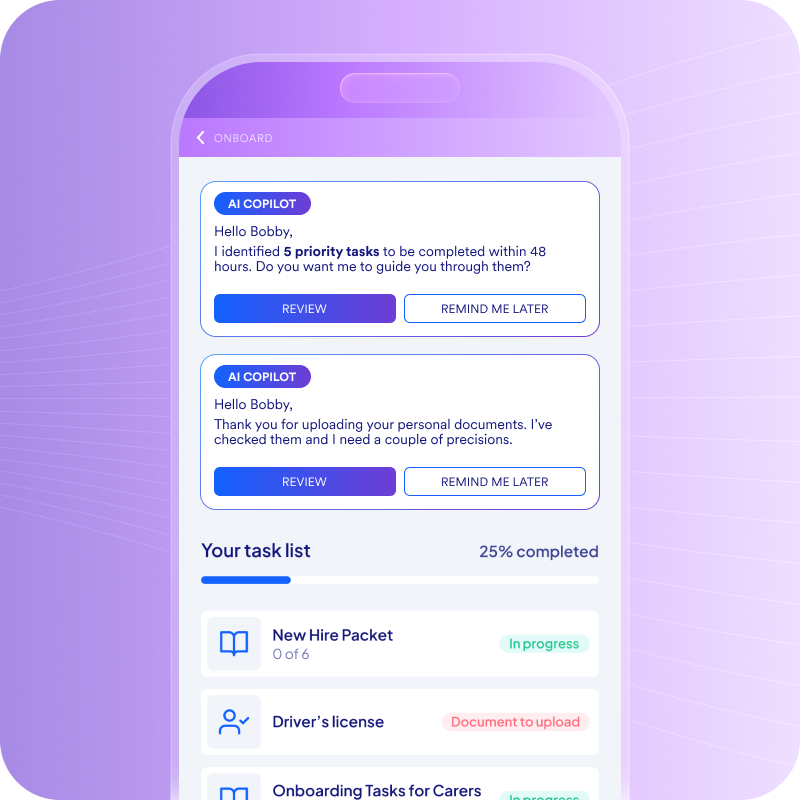
Faster ramp-up. Lower early attrition. AI onboarding built for speed, scale, and retention.
Top employers are already using Fountain’s Frontline OS to:
✅ Reduce turnover in the first 60 days
✅ Eliminate manual paperwork and task delays
✅ Accelerate new hire productivity with smarter workflows
Curious what smarter onboarding could unlock for your team?
A Nurse Licensure Compact multistate license covers RNs and LPN/VNs only. Each added site adds another board, which is where high-volume healthcare staffing strains first.
Nurse aide registry and exclusion checks
CNAs are listed on state nurse aide registries. The federal long-term care regulation addresses registry verification for nurse aides in 42 CFR § 483.35(d)(4) (eCFR, last amended December 3, 2025). Its text states that “Before allowing an individual to serve as a nurse aide, a facility must receive registry verification that the individual has met competency evaluation requirements,” followed by listed exceptions.
Paragraph (d)(5) separately covers state registries a facility believes will include information on the individual.
Some employers also screen staff against exclusion lists. OIG’s Special Advisory Bulletin (updated May 8, 2013) states that providers are not required by statute or regulation to check the List of Excluded Individuals and Entities (LEIE), and that a provider that employs or contracts with someone it knows or should know is excluded may be subject to civil monetary penalty (CMP) liability.
Some providers choose to screen monthly, a cadence the bulletin discusses in connection with potential overpayment and CMP liability. OIG has also announced a settlement over an excluded home health aide (September 2025).
A two-state CNA program shows how one role splits. In Texas, HHSC’s Employability Status Check lets providers verify nurse aide employability, including abuse, neglect, or misappropriation findings.
In Florida, the Board of Nursing says it does not require testing for candidates verified as actively certified and in good standing in another state, such as Texas.
Credentialing for security officers
Guard requirements vary by state, armed status, and post. California’s Bureau of Security and Investigative Services (BSIS) publishes the whole chain. Its fact sheet describes a DOJ and FBI criminal history check and completion of the Power to Arrest and Appropriate Use of Force course before a registration is issued.
Employers can confirm a current registration through the state’s license search, and BSIS says a guard may work while the card is pending with a printout of the Bureau’s approval and valid photo ID.
After registration, BSIS sets skills-training deadlines and annual continuing training, so the fact sheet’s current requirements are the reference. Armed posts add further requirements: an exposed-firearm permit covers only the calibers listed on the card and involves a separate firearms assessment.
Why credentialing breaks at volume
As hiring volume rises, the same discrepancy rate produces more cases, so reviewer capacity becomes a planning question. A missing license number or an expired date stalls the lookup until someone chases the candidate.
Name mismatches often have benign causes: E-Verify’s mismatch guidance lists a name change never reported to the Social Security Administration and an employer typing error.
How teams share ownership of renewals
One approach is to enter the next 30 days of expirations in the onboarding system with a primary and a backup reviewer, so shared tracking shows which renewal needs action even if one reviewer leaves.
One nursing home reported 173.5 hours worked by an RN whose license had expired on February 29, 2024; it said it hadn’t known before the audit and pointed to turnover in the director of nursing role. Nursys e-Notify is a free service that sends institutions license status and discipline updates, so an internal owner still handles follow-up.
In many organizations, that owner also decides what happens when a credential lapses, such as pulling the person from the schedule or holding them pending renewal, and records the decision.
Audit files commonly capture the date, source, result, and reviewer for each verification, along with a screenshot of each exclusion search.
Keep candidates moving
Meanwhile, the candidate decides whether to wait. Aptitude Research’s respondents point to candidate drop-off during the hiring process (26%), and a CNA who has cleared the registry check and is waiting on a manual exclusion screen may be weighing another offer.
How Fountain keeps credential checks moving
Credentialing stalls at the handoffs between recruiter, hiring manager, compliance owner, candidate, and issuing source. Cue is the intelligence that coordinates Fountain’s agents and products from a plain-language request.
A talent lead could type, “Set up CNA hiring for our Texas and Florida sites with the registry and exclusion checks each location needs,” and Cue surfaces the steps and prepares the workflow for a manager to approve. It can also flag incomplete documents for a person to resolve, and the hire decision never leaves your team.
Underneath, Fountain covers the handoffs in three places:
- Onboarding collects IDs, licenses, and credentials digitally, sends reminders for incomplete steps, and applies rules by location, role, and worker type.
- Fountain’s compliance capabilities can flag missing or incorrect documents in real time and route uploads to your verification vendor, with audit logs behind each step.
- Emma answers candidates’ questions and walks them through onboarding paperwork, and healthcare employers can set up recurring background checks for roles that require a license or certification.
Soothe, an on-demand wellness marketplace, reports that time to hire fell from 16 to 20 days, with verifications and licenses handled in separate steps, to 3 to 4 days after moving to Fountain, while onboarding 200 providers a month (a wellness result, not licensed-healthcare data). Boards, registries, BSIS, and OIG stay the sources of truth and your named reviewer stays accountable; Fountain runs the handoffs so the shift gets covered without skipping the check.
If credential tracking at your sites still lives in a spreadsheet, book a demo to see license collection, reminders, and recurring checks for licensed hourly roles.
Frequently asked questions about the credentialing process
What is primary source verification?
Primary source verification confirms a credential with the authority that issued it, such as a state board of nursing, a nurse aide registry, or BSIS, or with an approved agent of that source. A copy on file doesn’t qualify.
Can a new hire start work before credential verification is complete?
It depends on the role and the jurisdiction. For CNAs in nursing facilities, the federal regulation lists its own exceptions in 42 CFR § 483.35(d)(4), and the text is the place to read them. Some boards offer temporary paths: California’s nursing board issues temporary licenses to endorsement applicants, and BSIS describes a guard working while the card is pending in the circumstances noted above.
How often should we recheck licenses and certifications?
Practice varies by site and role. OIG’s bulletin states that providers aren’t required by statute or regulation to check the LEIE, some providers screen monthly, and some state Medicaid programs set their own monthly screening requirements, including Pennsylvania’s and Texas’s (as of October 2026). Some teams also tie rechecks to expiration dates and to board or registry updates.