Contingent labor is a margin-driven business. Staffing firms make money by closing the gap between client bill rate and the cost of sourcing, qualifying, onboarding, and keeping the worker on the job. The firms protecting margin in 2026 have rebuilt the cost stack with technology that runs the work, not technology that reports on it.
57% of frontline candidates cite slow hiring as their top frustration in the 2025 Fountain Frontline Report, compliance exposure compounds with every placement, and recruiter teams must fill more roles without growing headcount. Hiring costs have doubled since 2020, and replacement costs run $6,500 to $7,000 per frontline employee, or roughly 40% of annual pay. For a firm running 3,000 to 10,000 placements a year, every day of friction is a margin point on the floor.
What is contingent workforce management?
Margin in contingent labor lives in the gap between client markup and the cost of running the placement. Contingent workforce management is the full oversight of non-permanent workers (freelancers, contractors, temps, gig workers, agency placements) from requisition through offboarding. For a staffing firm, it’s the operating system behind every margin point. For the client buying the labor, it’s the procurement and compliance discipline that keeps the program honest.
Two seats sit at the table: the staffing firm runs supply (sourcing, qualifying, payroll, assignments), and the client runs demand (requirements, rates, governance).
Why do staffing firms lose margin without a managed program?
When a staffing firm runs without a managed internal program, the markup that looks like profit gets eaten by sourcing waste, turnover, manual onboarding, and compliance rework before the contract is half over. The cost stack underneath gross margin often runs on spreadsheets, point tools, and recruiter heroics.
- Sourcing spend leaks without attribution. Campaigns run across job boards, SMS, social, and paid channels with no view of cost-per-hire by channel, so the firm can’t cut what isn’t working or double the spend on what is.
- Time and expense get reconciled by hand. Hours and approvals move through spreadsheets and email instead of flowing into payroll, which slows invoicing and hides margin erosion until the quarter closes.
- Onboarding drops new hires between offer and Day 1. New hires leave within the first 90 days, with much of the damage concentrated before the worker ever settles into a shift, and every drop-out resets the cost-per-hire clock.
- Compliance runs as a separate checklist. I-9 and E-Verify get managed in a different system from hiring, with no audit trail when an inspection arrives and no way to catch a missed deadline before it costs a fine.
- Turnover compounds placement by placement. Replacement costs run into the thousands per frontline replacement, absorbed each time a worker walks.
The firms taking share treat the cost stack as a system, not a sequence of tickets. Every other approach leaks margin one process at a time.
How staffing firm markups actually work, and where the margin lives
Markups look like the staffing firm’s profit. They’re actually the budget that funds the entire internal cost stack.
Bill rate equals pay rate times 1 plus the markup. A 40% markup on a $20/hr role yields a $28/hr bill rate, but FICA, FUTA, SUTA, and workers’ comp consume the first dollars before recruiting or profit see anything.
At a 20% target markup on an $83/hr specialized role, the gap between a premium and a budget candidate is $16.60/hr, enough to flip the placement margin-negative. Net profit across staffing is often narrow, which is why the firms protecting margin in 2026 run a hiring strategy that turns each internal line item into an automated workflow.
VMS and MSP: How two operating models staffing firms work inside
Every staffing firm operates inside one of two governance models, sometimes both at once. A Vendor Management System (VMS) is software that centralizes vendor management and rate tracking. A Managed Service Provider (MSP) is an outsourced service that runs the client’s full contingent program, often layered on top of a VMS.
Staffing firms don’t choose between them; they operate inside whichever model the client picks. The competitive question is how fast the firm can post invoices, deliver compliance documentation, and report fill metrics into the VMS without adding back-office headcount.
How can direct sourcing be a margin lever for staffing firms?
Direct sourcing is where staffing firms either get disintermediated or become the partner clients can’t replace. It’s when a client builds its own curated pool of pre-qualified workers, hiring them without paying a traditional agency markup. In high-volume roles, it can materially cut the markup a client pays.
A working program has four parts: talent communities of previously engaged workers, employer brand activation so candidates apply to the client identity, applicant tracking integration that feeds curated pools into the hiring workflow, and employer-of-record partnerships that handle tax, benefits, and classification. Reactivating known-quantity workers eliminates new sourcing spend, where the margin advantage compounds.
Direct sourcing fits high-volume, repeatable roles in warehouse, retail, quick-service restaurants (QSR), last-mile delivery, and contact centers. The staffing firms hired to run the client’s program become embedded in the hiring engine; the ones that don’t get disintermediated when the client builds it itself.
What top staffing firms actually do to control internal cost-to-hire
The firms protecting margin compress every step of the internal cost stack. The pattern is consistent: standardize, centralize, automate, and measure.
- Standardize rate cards across every location and client. Bill and pay rates run from one source of truth so margin is set by policy, not negotiation, and the desk closing the deal can’t close a margin-negative one.
- Centralize hiring on a single ATS for every location and brand. One ATS runs the funnel for every role, region, and client. Marsden Services cut vacancy rates from 18% to 6% and time-to-hire from 18 to 7 days after implementing Fountain, and Bojangles reported an 80% drop in time-to-hire.
- Automate screening before a recruiter touches the queue. Knockout questions, location matching, availability filters, and automated phone screening get a qualified slate to the recruiter while the candidate is still warm. Liveops hit a 48% drop in time-to-fill with a 9-person team and 100% fill rates.
- Run onboarding and compliance as one workflow, not two. I-9, E-Verify, document collection, and Day 1 readiness move through the same system as the offer, through automated hiring workflows that replace manual handoffs. BELAY drove a 167% rise in monthly contractors hired and a 62% drop in time-to-hire after consolidating, and GoFor cut onboarding time by 83%.
- Make spend, conversion, and fill visible in real time. Every line of the cost stack is visible by location, client, role, and channel, in time to act before the next invoice cycle.
- Match bill rates to market conditions dynamically. Bill rates adjust to real-time labor signals so margin holds when conditions shift, instead of rolling forward on last quarter’s rate card.
The move from a stack of point tools to a single operating layer is the difference between a staffing firm whose margin shrinks with growth and one whose margin expands with it.
Compliance is the cost staffing firms underestimate the most
The United States Immigration and Customs Enforcement (ICE) served more than 5,200 I-9 audit Notices of Inspection in a two-phase nationwide operation. Staffing firms hiring at volume carry high per-worker exposure, and Fountain’s Employer’s Guide to I-9 Audits lays out the penalty math.
Paperwork violations run $288 to $2,861 per first offense. Knowingly employing an unauthorized worker runs $716 to $5,724 on first offense and scales to $28,619 per worker for repeat offenses. I-9 Section 2 must be completed within 3 business days of hire, and as of March 2026, ICE has expanded “substantive” violations to include errors that were previously curable.
Misclassification risk compounds alongside I-9 exposure: California’s AI employment regulations took effect October 1, 2025, paid sick leave coverage keeps expanding, and predictive scheduling rules reach more cities. Consolidating compliance into the hiring workflow reduces errors and gives auditors a single timeline to review.
Which metrics separate profitable staffing firms from the rest?
Cost-per-hire and time-to-fill are the metrics every staffing firm tracks. The ones that actually move margin are bill rate variance by location, Day 1 show rate, and 90-day contractor retention.
- Cost-per-hire (CPH) is the internal cost stack divided by hires. When CPH rises without a matching gain in retention, gross margin compresses directly.
- Time-to-fill measures the days from requisition to start date. It’s the clearest indicator of whether a staffing firm can meet client demand windows, and procurement teams treat it as a leading signal of supplier reliability.
- Bill rate variance by location flags where margin is eroding fastest. SIA’s US Staffing Industry Pulse Survey reported a net 0% trend in bill rates, with only 10% of firms expecting increases. Flat rates against rising pay translate directly into margin erosion.
- Fill rate is the share of open requisitions filled inside the service-level agreement (SLA) window. Procurement teams use it to decide contract renewals and supplier tiering inside MSP programs, and it’s where staffing firms either earn back the contract or lose the next one.
- Day 1 show rate is the share of hired workers who actually start the shift. Stitch Fix raised its Day 1 show rate from 68% to 95% by pairing mobile-first workflows with automated screening, and a no-show means full CPH incurred with zero billable hours.
- Contractor turnover at 30, 60, and 90 days reveals whether the placement was profitable. The early-attrition window decides whether onboarding earned its margin, and quality of hire remains a top success metric among staffing firms.
Every one of these metrics is downstream of the cost stack. A staffing firm that can’t see them in real time is running on yesterday’s information.
Frontline Superintelligence: The shift staffing firms can’t afford to miss
The next chapter of contingent workforce management is a hiring engine that runs work instead of reporting on it. AI agents are already reshaping recruiter economics, though the bill to the client stays the same. The shift is from systems of record that stored data and enforced workflows to systems that move work forward for the operator.
Salim Jernite, Chief Product and Technology Officer at Fountain, frames the shift as “intelligence that runs work, not software that reports on it.” Fountain’s Agentic AI layer turns every product into a system that doesn’t just analyze or assist, but acts on objectives, surfaces next steps for recruiter review, and asks for approval at the decision points the firm has flagged. Over time, it learns which sources convert, which screening questions predict Day 1 show rate, and which onboarding paths cut early attrition.
In Fountain’s benchmark data on agentic AI for frontline hiring, agentic systems cut time-to-hire from 14-plus days to 6 to 8, drop-off from 35% to 18%, and recruiter workload per hire by 60% to 70%. Constitutional AI safeguards, audit logs, and bias auditing apply, with human review and override at flagged decision points.
How Fountain runs the contingent cost stack
Margin gets defensible when sourcing, screening, onboarding, and compliance run inside one orchestrated workflow instead of across spreadsheets and point tools. This is Fountain’s Frontline Superintelligence stack: an orchestration layer above three named agents and the products they run, turning each cost-stack line item into an automated step rather than a recruiter task.
Cue sits above the agents. A staffing firm operator moves work in plain English (“Hire 50 warehouse associates for Monday’s client launch, prioritize candidates from our reactivation pool”), and Cue routes the work across the platform. Every action is logged, giving the firm an audit trail and the client a single timeline to review.
Under Cue, three agents do the work.
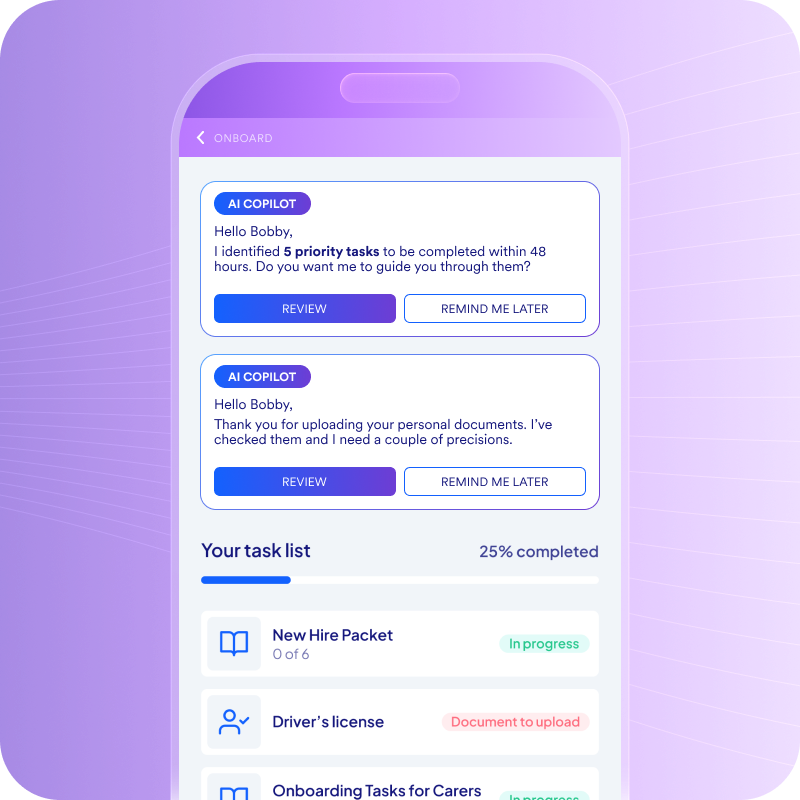
Anna conducts voice interviews around the clock, scoring responses and surfacing qualified slates to recruiters in minutes; per Fountain platform data, 74% of applicants choose her over waiting for a human recruiter. Emma, the I-9 and W-4 Consultant, guides workers through paperwork on SMS and chat so blockers clear in real time instead of stalling time-to-hire. Sam takes the pulse of the workforce post-hire and surfaces early attrition signals so the firm can intervene before 90-day turnover triggers another full CPH cycle.
The agents operate on Fountain’s core products:
- Sourcing optimizes multi-channel spend against hire outcomes
- CRM keeps reactivation pools ready to redeploy without net-new sourcing spend
- ATS runs configurable workflows by role, location, and brand
- Onboarding handles mobile I-9 completion, E-Verify submission, and audit-ready storage
- Shift & Scheduling closes the post-placement coverage loop so client SLA windows hold.
The staffing firms winning in 2026 treat the cost stack as one system that completes work, learns from every placement, and protects margin. Every day of friction is a margin point on the floor; the operating layer is what keeps those points from rolling off every quarter.
See it on a live workflow. Book a demo to walk through an Anna-driven voice interview, an Emma-guided I-9 flow, and the audit trail Cue generates from a single plain-English prompt.
Frequently asked questions about contingent workforce management
What does a staffing agency markup actually cover?
The markup covers mandatory employer-side costs (FICA, FUTA, SUTA, workers’ comp), recruiting and sourcing spend, background checks, onboarding, compliance administration, and ongoing support. Net profit margins are typically thin, which is why staffing firms protecting margin in 2026 are compressing every internal cost-stack line item that markup is paying for.
What is the difference between a VMS and an MSP?
A Vendor Management System (VMS) is software that centralizes vendor management, rate tracking, and reporting for a client’s contingent labor program. A Managed Service Provider (MSP) is an outsourced service that runs the client’s contingent program end-to-end, often using a VMS as the underlying technology. A client can run a VMS without an MSP, but an MSP almost always runs on top of a VMS.
How does direct sourcing reduce contingent workforce costs?
Direct sourcing builds curated talent communities of pre-qualified workers the client engages directly, often at materially lower markups than net-new agency placements. Savings compound when the client reactivates former workers, and the staffing firms that run the direct sourcing program become embedded in the hiring engine rather than competing with it.