60% of frontline retail workers turn over every year, according to the 2025 Fountain Frontline Report. At that level of turnover, hiring becomes continuous operational infrastructure. When that infrastructure depends on a chain of disconnected tools, shifts go uncovered, store managers spend the day plugging holes, and locations open short. Frontline Superintelligence changes what retail operators can expect from hiring infrastructure by turning disconnected steps into coordinated execution.
This article covers what Frontline Superintelligence means in a retail context, where the operational gains show up, what it looks like across multi-location retail, and how the architecture actually runs.
What is Frontline Superintelligence for retail?
In retail, hiring has historically run on a chain of disconnected tools: an applicant tracking system for applications, a calendar tool for interviews, an HRIS for onboarding, a scheduling app for shifts. Frontline Superintelligence collapses that chain into a multi-agent execution layer that runs hiring, onboarding, scheduling, and retention as coordinated work. Application data, screening, candidate communication, document collection, scheduling, and compliance flow through one architecture instead of a chain of human handoffs.
After hiring-team review or configured rules, screening results advance candidates into the next step. An accepted offer starts onboarding paperwork. A completed background check can move a worker into scheduling when the required approvals are in place. Each step feeds the next without waiting for someone to log in and push it forward.
“Intelligence that runs work, not software that reports on it,” says Salim Jernite, Chief Product and Technology Officer at Fountain.
The distinction matters operationally. A chatbot surfaces application status to a candidate. A multi-agent system screens that candidate, schedules the interview, completes onboarding documents, prepares a first shift, and flags retention risk before the first 30 days, with hiring teams keeping final decision authority.
The chatbot operates as an information layer. The multi-agent system operates as an agentic AI execution layer. For a retail operator managing open roles across multiple locations, that gap determines whether stores open fully staffed or start the week short.
Why retail is built for agentic AI hiring
Retail has the conditions agentic AI needs to outperform manual processes. The structural characteristics below make it a clean fit:
- Structured data: Application fields, role requirements, certification needs, and retention outcomes are already standardized across most retail roles (cashier, stockroom, sales associate, fulfillment). The inputs are consistent enough for agents to act on without custom configuration per role.
- High-volume repetitive decisions: Every shift, every turnover event, and every seasonal spike triggers the same chain of sourcing, screening, interviewing, onboarding, and scheduling decisions, and retail’s turnover rate makes that chain run thousands of times a year.
- Time-sensitive outcomes: A missed staffing decision means an unstaffed register, a stockroom that can’t break down a truck, or a coverage gap during peak. The cost is immediate.
- Multi-location pattern: The same hiring workflow has to run across 50 to 5,000 locations under one brand, and a district manager cannot manually equalize 200 store managers running 200 different hiring processes.
When all four conditions are true, the bottleneck stops being a tooling problem and becomes a coordination problem. Multi-agent systems are built to solve coordination problems.
What are the benefits of Frontline Superintelligence for retail?
The leverage shows up in five places, and the gains compound because each one feeds the next:
1. Apply-to-first-shift in hours, not weeks
In retail, speed decides whether you staff tonight’s close shift or lose the applicant to the competitor down the street who responded first. Agentic AI compresses the path from submission to first shift into a single business day.
A candidate completes a mobile application quickly. AI-driven screening scores them against role-specific performance criteria. After hiring-team review or configured approval, calendar sync pulls available interview slots from the store manager’s schedule and books one without back-and-forth. After the interview and final hiring-team approval, offer and onboarding paperwork fire automatically. The candidate can be ready for the schedule before many retailers would typically respond.
Fountain’s Agentic AI for Frontline Workforces research puts numbers on the compression: AI screening cuts screening time by 40% and time-to-interview by 79% compared to manual processes. Those gains scale across every open req in the network.
2. Continuous applicant flow that scales with seasonal demand
Many retail operators still rebuild their applicant pipeline every time they need to hire. For seasonal hiring, that approach is structurally broken. Seasonal hiring works better when it starts from a warm pool instead of a cold start.
Continuous applicant flow keeps past applicants in a candidate database with qualifications and history intact, ready to re-engage when seasonal demand returns. When a store needs to hire for Black Friday or back-to-school, the first move is pulling qualified past seasonal workers who already know the role, the brand, and sometimes the location.
Re-engagement strips out the sourcing spend that would otherwise be needed to refill the funnel and shortens the path from open req to first shift, since alumni already cleared screening once before.
3. 24/7 candidate communication that meets mobile-first applicants where they are
Frontline retail hiring is mobile-heavy, and candidate drop-off often happens in the gap between when someone applies and when a manager responds.
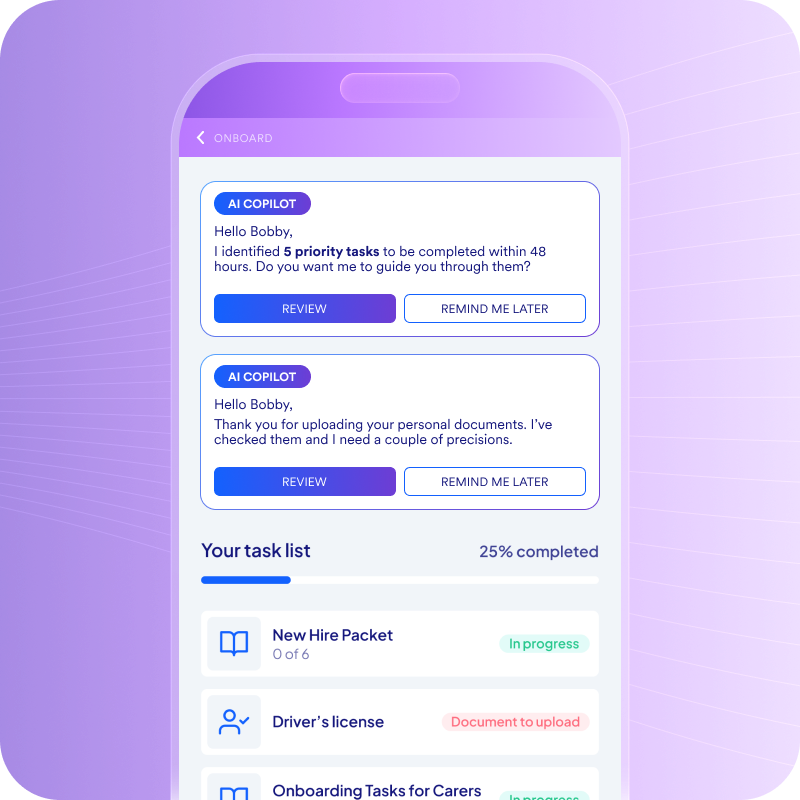
Agentic candidate support runs across SMS, chat, and WhatsApp to close that gap. It answers application questions in real time, sends interview reminders, confirms shift details, and handles common reschedules without pulling a store manager off the floor. Managers see the conversations afterward. Candidates get the real-time applicant engagement they need to stay in the funnel.
4. Onboarding that completes before the first shift
In a typical retailer, onboarding bleeds into the first week of work. I-9 verification gets pushed to “we’ll do it Monday.” Tax forms sit unsigned and background checks run late. The cost shows up later as compliance exposure or, worse, a no-show on the first shift because the candidate never finished their paperwork.
Agentic onboarding compresses that into hours. The moment an offer is accepted, document collection fires automatically. Verification and form completion move through the onboarding workflow on mobile. Background checks can start without manual triggering.
By the first shift, the worker is documented, verified, approved, scheduled, and ready to work the floor.
5. Cross-location visibility for district managers and regional ops
Multi-location retail ops have a visibility problem that compounds with every new store. Some locations are fully staffed and running smoothly. Others bleed shifts every weekend, and no one in regional ops knows why. Manual reporting becomes harder to maintain as store count grows.
A unified system gives every store, every funnel stage, and every drop-off point a single view. District managers see which locations are slow at screening, which are losing candidates between offer and first shift, and which managers haven’t responded to applicants in 48 hours. The intervention shifts from reactive (“this store is short tonight, scramble”) to predictive (“3 stores in the Phoenix district are trending toward shortfall next week, here is where to focus”).
In retail, those gains compound. The same architecture runs across every location at once, so a district manager who fixes a screening bottleneck in one store can roll the fix across the region the same week.
Frontline Superintelligence for retail in action
A multi-agent execution layer that runs across multiple retail facilities shows up in 3 places at once: time-to-hire compresses, day-one show rates climb, and recruiter and manager time gets reclaimed. The same architecture works across high-turnover and low-turnover seasons, across formats.
Stitch Fix is one of the clearest examples. The personal styling service operates fulfillment centers across the U.S. and hires warehouse associates at high volume. Before switching to an agentic execution layer, their process was mostly manual. Time-to-hire ran nearly 3 weeks. Day-one show rates were low enough to materially affect productivity. Building a centralized recruiting team required tools that could test interview styles and screening flows quickly.
After the switch, the hiring process became more streamlined:
- Day-one show rate climbed 40%, from 68% to 95% of applicants who pass background checks.
- Median time-to-hire compressed from 21 days to 9 days.
- A/B testing on interview flows let the team iterate against actual conversion data.
- New facility openings, including Salt Lake City, were launched using Fountain’s hiring workflow.
Those changes gave the team faster hiring, stronger day-one yield, and a workflow they could reuse across facilities.
One finding was particularly instructive. Fully automated offer-stage paths produced lower show rates than paths with human contact at the offer stage. The team rebuilt the handoff based on that data, and show rates jumped to 95%. The right model is orchestrated AI that knows when to insert human judgment over full automation at every step.
Same brand, same operational standards, faster hiring, higher day-one yield, and a workflow that ports to a new facility without rebuilding from scratch. Coordinated agent work, running across multi-location retail operations.
Where Frontline Superintelligence fits across retail operations
The shape of the deployment depends on the size of the operation. Two patterns dominate.
1. For specialty retail and regional chains
Specialty retailers and regional chains with a handful to a few hundred locations need the system to be lightweight enough for a store manager mid-shift. Lean corporate teams and store managers running hiring without dedicated HR support define this tier. The deployment usually centers on:
- Mobile-first applicant tracking: Move candidates from apply to hire with minimal manager touch, since most applications happen on a phone between shifts.
- Automated screening and self-scheduled interviews: Candidates clear knockout questions and book themselves into a store manager’s available slot.
- Day-1 onboarding readiness: I-9, W-4, and background checks complete before the first shift so the worker is ready to work the floor on Day 1.
- 24/7 candidate communication: Agentic candidate support covers questions outside store hours so applicants don’t drop off waiting for a response.
What to look for in this tier is speed at the candidate touchpoint and minimal admin load on store managers. If the system can’t be operated from a phone during a real shift, frontline managers won’t use it.
2. For enterprise retail and multi-brand operators
Large enterprise retailers and multi-brand portfolios with hundreds to thousands of locations need standardization, compliance, and visibility, not just speed. Hiring is distributed across regions but has to roll up to centralized control. Agency spend is usually high and compliance exposure is real, with paperwork rules, scheduling laws, and state-by-state labor requirements varying across every region.
The deployment runs deeper:
- Standardized applicant tracking workflows: One platform enforces consistent hiring steps across every brand and banner without forcing each region into the same rigid template.
- Sourcing automation that reduces agency reliance: Multi-channel campaigns running against actual hire outcomes shift spend toward channels that produce day-one-ready workers.
- Cross-region compliance and audit trails: Centralized I-9, E-Verify, and document tracking holds up under audit and surfaces gaps before they become exposure.
- AI voice screening throughput: Agentic voice screening lifts throughput during seasonal spikes, so seasonal demand doesn’t require linear recruiter headcount growth.
- Shared candidate pipelines across brands: A candidate database with unified Talent Profiles lets one banner re-engage workers another banner already cleared.
The bar for this tier is hiring consistency, audit-ready compliance, lower agency spend, and the ability to grow candidate throughput without growing the recruiting team store for store.
How Fountain runs Frontline Superintelligence for retail
Fountain runs Frontline Superintelligence for the global frontline workforce, used by retail brands to coordinate hiring, onboarding, and retention as one connected workflow. Cue sits at the top of the system as the orchestration layer, translating plain-English goals like “rehire our top seasonal workers from last year, good standing only” or “surface candidates for the holiday hiring push, sorted by past day-one show rate” into coordinated work that logs every step.
Underneath Cue, three named agents do the work. Anna runs voice screening for high-volume retail hiring, conducting actual phone interviews and pushing qualified candidates to TA managers. Emma handles 24/7 candidate support across SMS, voice, and chat, so applicants get answers when they are applying between shifts at 11 p.m. Sam takes the pulse of new hires after Day 1 to flag retention risk before it costs a worker.
The platform sitting underneath the agents covers ATS, Sourcing, CRM, Onboarding, and Shift & Scheduling. Workflows are configurable per brand, and enterprise-grade AI infrastructure with Constitutional AI safeguards powers every agent action, with audit logs, approval flows, and human override built in.
Ready to staff tonight’s close shifts without a manual scramble? Book a demo to see Cue coordinate Anna on voice screening, Emma on 24/7 candidate questions, and Sam on retention flags against a real multi-location retail funnel, with cross-location visibility built in for high-volume hiring programs.
Frequently asked questions about AI for retail hiring
How does AI reduce time-to-hire in retail?
AI-driven screening, interview scheduling software, and automated onboarding document collection move candidates from application to first shift without waiting for manual handoffs at each step. According to Fountain’s Agentic AI for Frontline Workforces research, agentic screening cuts screening time by 40% and time-to-interview by 79% compared to manual processes.
Can AI hiring tools work across multiple retail locations?
A multi-agent system runs the same workflow across every location from a single architecture, with configuration options per store, brand, or region. District managers get cross-location visibility into funnel performance, drop-off points, and staffing gaps without building manual reports.
How is agentic AI different from chatbots for retail hiring?
A chatbot answers candidate questions and follows scripted branching logic. An agentic AI system handles the screening workflow, schedules the interview, sends reminders, initiates the background check, and re-engages the candidate for a different role if they don’t get this one, all as a coordinated sequence pursuing a defined hiring goal while hiring teams keep final decision authority. The chatbot responds. The agent executes.