Greenhouse holds the #1 ATS position on G2 and is a strong system for corporate recruiting, but the model breaks when a frontline team pushes 500 or 5,000 applicants a week through software designed for a recruiter managing 15 to 20 open roles. Additionally, Aptitude Research reports that 1 in 4 companies are replacing their ATS in 2025, with 82% citing significant functionality gaps.
In other words, software is becoming the back end and agents are becoming the front end. The 2026 question for frontline hiring teams is whether the agentic capabilities can actually screen candidates, answer questions at 2 a.m., schedule interviews, and run onboarding without a recruiter touching the keyboard.
This guide ranks Greenhouse alternatives through both lenses: the platform underneath, and the agents on top.
TL;DR: Greenhouse competitors at a glance
- Fountain: Frontline hiring and workforce platform running agentic screening, 24/7 candidate support, and post-hire engagement under one orchestration layer.
- Paradox (Workday): Conversational AI assistant (Olivia) for candidate engagement and interview scheduling.
- iCIMS: Enterprise ATS with a frontline AI suite added post-Apli.
- SmartRecruiters (SAP): Modern recruiting platform with AI sourcing and screening assistants, now part of SAP.
- Workstream: SMS-first hiring and workforce platform for restaurants and retail.
- Lever (Employ Inc.): ATS plus CRM (candidate relationship management) for relationship-driven pipelines.
- Workable: Mid-market ATS with broad job board distribution.
For frontline teams that need to move applicants from search to start date with agents running the workflow, Fountain is the most direct fit. The rest of this guide explains why, and where each alternative makes sense.
What is a frontline ATS?
Volume is the dividing line. A corporate ATS is optimized for 15 to 20 open roles per recruiter. A frontline ATS is optimized for thousands of weekly applications, mobile-only candidates, site managers reviewing from a phone, and I-9 and E-Verify clearing inside the hiring flow. The category exists because 50 applicants a month and 50,000 demand different products, not a volume slider on the same one.
The term covers applicant tracking software built for high-volume, hourly hiring in QSR (quick-service restaurants), retail, logistics, healthcare, and staffing.
How we evaluated these platforms
A frontline ATS lives or dies on whether real applicants finish the application and start their shift on time. We ran each platform through six checks, ordered by what matters most:
- Started with agentic depth. Platforms that ship agentic capabilities running the work rated higher than those whose AI just surfaces insights for a human to act on.
- Required a mobile-first application path. According to Fountain’s Redefining Frontline Operations white paper, 60% of applicants abandon applications that aren’t optimized for mobile.
- Measured speed from application to offer. Recruiter workload is up 30% since 2020, and candidates with options take the first offer that lands.
- Tested hiring manager usability on a phone. Frontline managers don’t sit at desks, and the ones who do are the bottleneck.
- Confirmed HRIS and payroll integration paths. Frontline employers run an HCM (human capital management system) underneath the ATS, so a six-month integration project is a dealbreaker.
- Checked compliance and post-hire capabilities. I-9, E-Verify, background checks, and credential verification belong inside the hiring flow, not handed off to a point solution.
A platform had to clear most of these to land on the list.
| Dimension | Fountain | Paradox (Workday) | iCIMS | SmartRecruiters (SAP) | Workstream | Lever | Workable |
| Primary market | Frontline hiring and workforce | Conversational AI for frontline hiring | Enterprise talent acquisition | High-volume recruiting in SAP | Hourly workforce in restaurants and retail | ATS + CRM for pipelines | Mid-market ATS |
| Agentic capabilities | Orchestration layer over voice screening, 24/7 multi-channel candidate support, and post-hire engagement | Olivia, a conversational chatbot | iCIMS Frontline AI suite (March 2026) | AI sourcing and screening assistants | SMS-first rule-based automation | AI-assisted candidate matching | AI screening assistance |
| Mobile-first apply | Yes (mobile-native ATS) | Yes (SMS / web chat) | Improving (Apli) | Modern candidate processing in SAP | Yes (SMS / QR code) | Mobile apps | Mobile-friendly |
| Post-hire coverage | Full lifecycle (Onboarding + Shift & Scheduling) | Routed through Workday | Separate iCIMS Onboarding module | Routed through SAP SuccessFactors | Onboarding + workforce management | ATS + CRM only | ATS only |
| HRIS integration | UKG, SAP, ADP, Workday (native) | Native Workday | 800+ partners (HCM-agnostic) | Native SAP | ADP certified | Standard | Standard |
| Compliance / I-9 | Native I-9, E-Verify, compliance dashboard | Through Workday | Partner integrations | SAP ecosystem | Background check integrations | Not compliance-first | Not compliance-first |
The agentic capabilities row is where 2026 buyers should weight the comparison, because that’s where the work is moving from a recruiter’s task list to an agent-run workflow.
The Top 7 Greenhouse Competitors for High-Volume Frontline Hiring
1. Fountain
Fountain is a frontline hiring and workforce management platform built for high-volume employers in QSR, retail, logistics, staffing, and healthcare, with over 1.2 million workers hired annually across 78 countries.
The platform runs three layers: an orchestration layer above agentic capabilities for voice screening, 24/7 multi-channel candidate support, and post-hire engagement; and a product layer underneath that includes the ATS, Onboarding (mobile I-9 and E-Verify with a real-time compliance dashboard), Shift & Scheduling, CRM, and Sourcing. Native integrations with UKG, SAP, ADP, and Workday let the ATS replace Greenhouse without replacing the HRIS (human resources information system).
According to the 2025 Fountain Frontline Report, 74% of frontline workers prefer AI voice interviews and 43% of new hires leave within 90 days, making agentic screening and post-hire engagement load-bearing for any frontline employer.
Proof:
- Liveops cut time-to-fill by 48% and reached 100% fill rate at a 44,000:1 applicant-to-recruiter ratio
- Marsden Services moved vacancy rate from 18% to 6%
- Fetch cut time-to-hire by 95% using Fountain’s agentic screening.
Pros:
- Three agentic capabilities under one orchestration layer cover the full worker lifecycle
- Native HCM integrations let the ATS replace Greenhouse without replacing the system of record.
Cons:
- Purpose-built for frontline, not corporate hiring
- Less suited to organizations hiring fewer than a few hundred frontline workers annually.
Best for: Frontline employers hiring hundreds to thousands of workers across multiple locations who need a single platform from application through first shift, strongest in QSR, retail, and logistics, outsourced services, and healthcare.
2. Paradox (Workday)
Paradox is a conversational AI platform built around Olivia, a virtual assistant that automates screening, scheduling, and candidate communication. Workday announced its intent to acquire Paradox in October 2025, and the Paradox Conversational ATS launched through Workday in January 2026. Named clients include Chipotle and 7-Eleven.
Pros:
- Strong conversational AI with a proven QSR track record
- Clean change management for organizations already running Workday HCM.
Cons:
- Olivia is a single conversational agent, not an orchestration layer
- No native post-hire products
- The integration roadmap for non-Workday customers hasn’t been published.
Best for: Workday HCM customers who want to add conversational AI for frontline hiring without switching their core ATS.
3. iCIMS
iCIMS is an enterprise talent acquisition platform used by more than 40% of the Fortune 1500. It expanded into frontline hiring through the 2025 Apli acquisition and launched its Frontline AI suite in March 2026. The UNIFi API framework supports 800+ integrations.
Pros:
- Configurability and account management are recurring strengths in reviewer feedback
- Strong fit for non-Workday, non-SAP HCM stacks.
Cons:
- Navigation complexity creates adoption barriers for frontline hiring managers
- The Frontline AI suite is recent and the frontline experience is bolted onto an enterprise foundation.
Best for: Large enterprises with dedicated TA infrastructure on non-Workday, non-SAP HCM stacks who need an HCM-agnostic ATS.
4. SmartRecruiters (SAP)
SmartRecruiters is a modern recruiting platform that SAP announced its acquisition of in August 2025 and closed in September. It is recognized as a Leader in the 2025 Gartner Magic Quadrant for Talent Acquisition Suites, with AI-enabled sourcing and recruitment automation and an integration path into the SAP SuccessFactors ecosystem.
Pros:
- Verified Gartner reviewers describe the candidate processing interface as highly intuitive
- The SAP acquisition strengthens enterprise distribution and SuccessFactors integration.
Cons:
- SAP hasn’t published a roadmap for combining SmartRecruiters with existing SuccessFactors recruiting tools
- AI assistants aren’t orchestrated through a copilot layer.
Best for: Organizations running SAP SuccessFactors who want a more modern recruiting experience and accept integration roadmap uncertainty.
5. Workstream
Workstream is a hiring and workforce management platform built for the hourly workforce in restaurants, retail, and hospitality. The platform centers on text-to-apply via QR codes and unique SMS numbers, with two-way SMS messaging throughout the candidate journey, and extends into scheduling and time tracking. The mobile app supports English, Spanish, and Simplified Chinese.
Pros:
- SMS-first hiring flow built for operators capturing applicants on the floor
- Multilingual mobile app suited to restaurant and retail workforces.
Cons:
- Integration options aren’t as extensive as larger suites
- Automation is largely rule-based SMS rather than agentic workflows.
Best for: Franchise operators and small-to-mid-market frontline employers who need SMS-first hiring without enterprise complexity.
6. Lever (Employ Inc.)
Lever combines ATS and CRM capabilities in a single interface, with pipeline management tools that help organizations build talent pools ahead of seasonal or growth-driven hiring surges.
Pros:
- ATS and CRM in one interface supports relationship-driven hiring teams
- Useful for building talent pools ahead of future demand.
Cons:
- High-volume frontline hiring is identified as a platform boundary
- No named agentic capabilities for screening, candidate support, or post-hire engagement.
Best for: Growth-stage companies focused on relationship-driven pipeline building for professional roles, not high-volume frontline hiring.
7. Workable
Workable is a mid-market ATS with an intuitive interface, broad job board distribution, and low training requirements.
Pros:
- Intuitive interface with low training requirements
- Broad job board distribution.
Cons:
- Not built for high-volume or frontline hiring
- AI features are screening-assistance rather than orchestrated agentic workflows.
Best for: Lean TA teams at smaller organizations hiring up to a few hundred people annually who need an intuitive ATS without frontline-specific requirements.
How the Fountain’s agentic layer runs the frontline hiring workflow
Fountain isn’t a faster Greenhouse for the frontline; it’s a different category of tool. Where a corporate ATS automates a recruiter’s task list, Fountain runs the hiring workflow itself through Cue, the orchestration layer that takes natural-language goals like “Hire 50 warehouse associates in Dallas by Monday, prioritize rehires in good standing” and breaks them into coordinated work across the ATS, sourcing, CRM, onboarding, and scheduling.
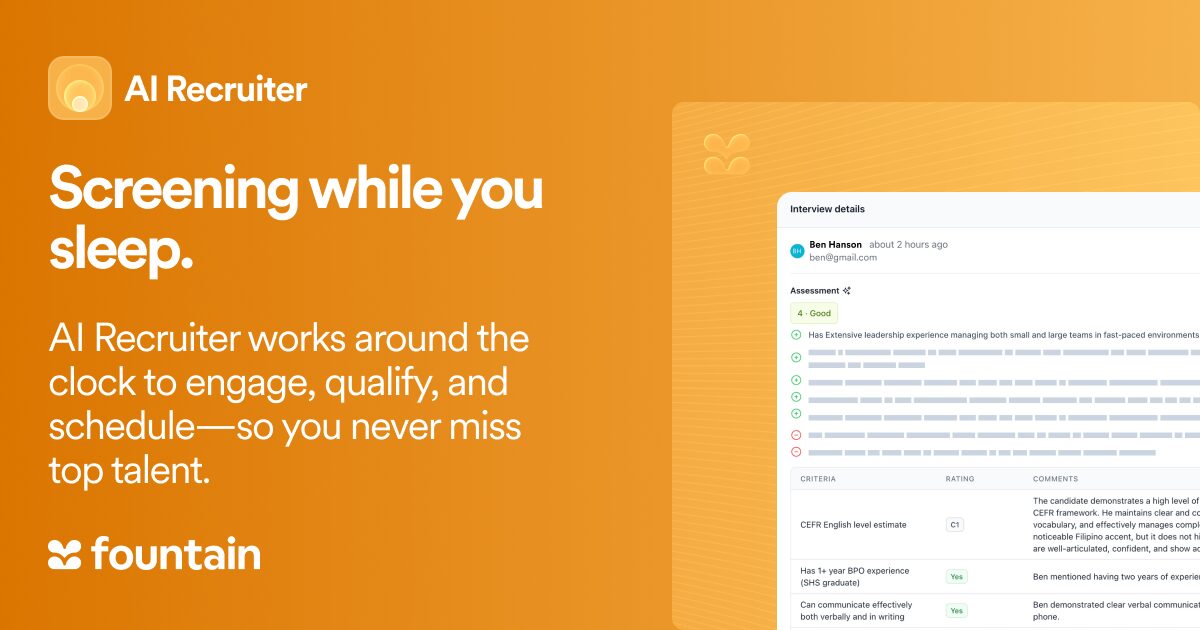
Underneath Cue, three named agents do the work. There’s Anna, who conducts voice interviews on demand, scores candidates against the role, and pushes qualified applicants to TA managers; at CLEAR, that capability cut time-to-fill from 17 days to 10.
Then Emma handles 24/7 candidate support across SMS, voice, web widget, and WhatsApp, while Sam takes the pulse of new hires through their first weeks, surfacing retention risks before the first 90 days when 43% of frontline workers leave.
The product layer underneath covers the full lifecycle: a mobile-native ATS, Onboarding with mobile I-9 and E-Verify, Shift & Scheduling, CRM for talent rediscovery, and Sourcing with multi-channel budget management. Native integrations with UKG, SAP, ADP, and Workday mean the ATS replaces Greenhouse without replacing the HRIS. Stitch Fix raised its day-one show rate by 40%; Bojangles cut time-to-hire by 80%.
The 2026 choice for frontline hiring teams replacing Greenhouse is straightforward: an ATS with AI features bolted onto a recruiter’s workflow, or a frontline operating system with named agents already running it.
If your hiring team is ready to move applicants from search to start date with agents running the workflow, book a demo to see Cue route a live funnel, watch Anna run a voice interview, and tour the compliance dashboard Emma uses to keep onboarding moving.
Frequently asked questions about Greenhouse competitors
How does Greenhouse compare to a frontline ATS for hourly hiring?
Greenhouse is built around the recruiter-led, role-by-role motion of corporate recruiting. A frontline ATS is built around mobile applicants, site-manager review, SMS-first communication, and integrated I-9 and onboarding compliance. The gap widens with volume: a Greenhouse workflow that handles 200 applications a month cleanly will buckle at 20,000. See the ultimate guide to high-volume hiring for the operational differences.
Can a frontline ATS work alongside an existing corporate ATS?
Yes. Many large employers run Greenhouse for professional roles and a separate frontline platform for hourly roles. The corporate ATS handles 15 to 20 reqs for knowledge workers; the frontline platform handles thousands of weekly applications across locations. The dual-ATS approach works if the HRIS-of-record is unified downstream.
Will AI agents replace recruiters in frontline hiring?
Not in the way the headlines suggest. Agentic capabilities handle the repetitive parts of a frontline recruiter’s day: voice screening, candidate Q&A, scheduling, and post-hire check-ins. Per the Fountain Frontline Report, 74% of frontline workers prefer an AI-driven interview. Recruiters still own the relationships and the hiring decisions, while agentic AI for frontline hiring shrinks the volume of administrative tasks rather than the role.