Retail turnover runs 81% annually, according to Fountain’s 2025 frontline trends data. Replacing a frontline worker costs $6,500 to $7,000, about 40% of annual pay, per Redefining Frontline Operations. Every hire who walks away is money already spent on sourcing, screening, and paperwork that produced nothing.
A late or confusing onboarding process can turn an accepted offer into a no-show; a clear one gets the associate to the first shift ready to work. It’s the difference between a new associate who’s confident on the floor by week two and one who never shows up for their second shift.
Retail onboarding starts at offer acceptance, breaks most often during preboarding and Day 1 handoffs, and needs mobile paperwork, manager follow-up, role training, and compliance checks to keep new hires through their first 90 days.
What is retail onboarding?
Retail onboarding is the structured process of moving a new hire from accepted offer to a productive, compliant, and retained employee. It covers paperwork, compliance verification, role and product training, and the cultural connection that makes someone feel part of the team. A strong onboarding process reduces no-shows, completes compliance steps on time, and gets the hire ready to handle the first shifts.
Orientation is a single welcome event, the here’s-your-locker, here’s-the-break-room moment that fits inside onboarding as one component. SHRM’s onboarding guidance frames onboarding as the full process of integrating new employees across the first year, spanning preboarding, orientation, foundation building, and mentoring. That longer arc matters in retail because leaders who stop after Day 1 orientation lose the chance to catch training gaps before the 90-day attrition window closes.
Retail onboarding also differs sharply from corporate onboarding. Corporate hires often get a slow 90-day ramp with executive lunches and desk setup. Retail associates need to be productive within days, sometimes the same day they are hired. They are hourly, high-volume, subject to heavy compliance requirements, and completing everything on a phone because they have no desk and no corporate email.
That speed means retail onboarding has to compress setup, paperwork, and core-task practice before uncovered shifts turn into service gaps. Measure success by how quickly the associate can handle core tasks with confidence.
Why retail onboarding breaks down
Retail onboarding fails in predictable ways, and every failure traces back to a process built for a slower, desk-bound worker. Paper packets get lost between the hiring manager and HR, manual follow-up doesn’t scale past a handful of hires, and generic training feels impersonal to someone about to face customers on Day 1.
Compliance steps get skipped when a store manager is scrambling to cover a shift by Friday.
Multiple stores and high-volume hiring spikes make each handoff harder to control. When every store runs onboarding differently, HR loses a single view of forms, deadlines, and new-hire progress. Seasonal hiring compresses all of it into a few weeks, and stores that shorten training and run just-in-time vetting leave new hires underprepared and disengaged.
Day 1 no-shows usually mean the offer-to-start process failed. Roughly one in five companies experience at least one Day 1 no-show, per Aptitude Research. Attrition continues well past Day 1: according to Fountain’s 2025 frontline research, 43% of new hires leave within 90 days.
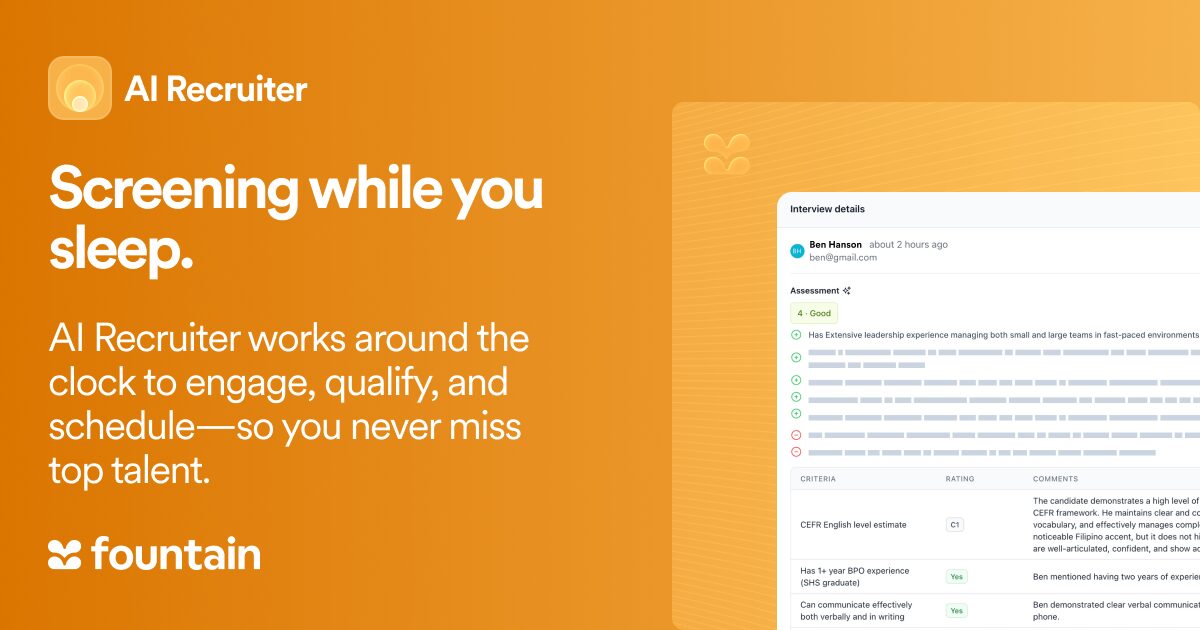
See How Fountain’s AI Recruiter Uses Agentic AI to Cut Screening Time by 79%
Fountain’s AI Recruiter leverages Agentic AI to transform how hiring gets done—screening candidates, scheduling interviews, and surfacing insights automatically. No prompts. No bottlenecks. Just faster, smarter, always-on hiring.
If your team is stretched thin or struggling to keep up with high-volume roles, now’s the time to see what Agentic AI can do.
When onboarding is an afterthought, those two numbers move together and leave stores covering last-minute vacancies while restarting the hiring process.
Preboarding: the window before Day 1
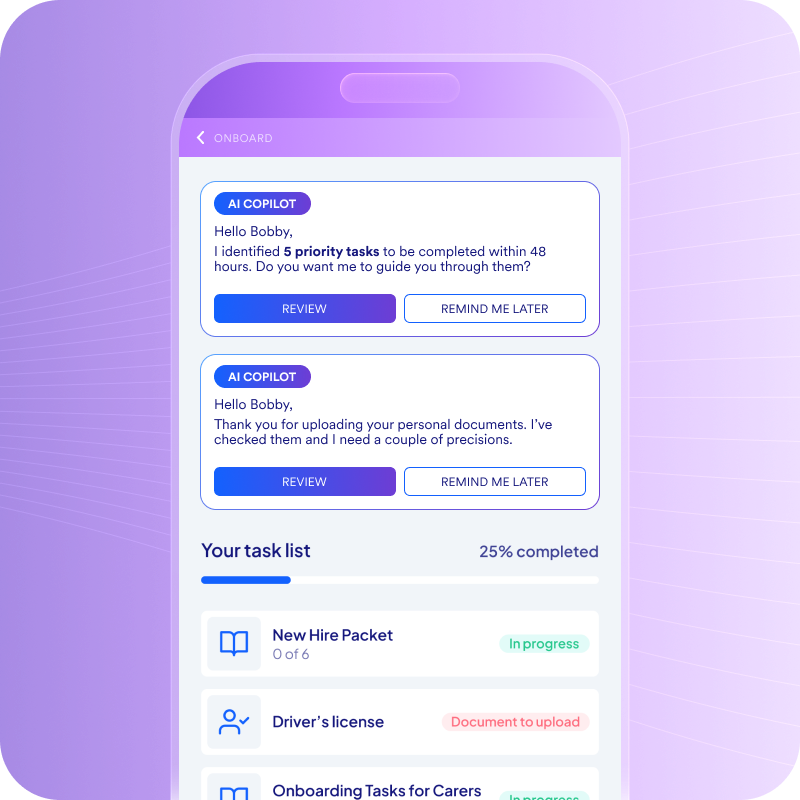
Preboarding determines whether an accepted retail offer becomes a Day 1 start, so use the offer-to-start window to complete mobile paperwork, provision access, welcome the hire, and assign a buddy before the first shift. A mobile preboarding checklist that opens the moment the offer is accepted lets managers see who has finished each task before Day 1.
The payoff is a first shift that focuses on team introductions, store routines, and hands-on practice instead of back-office forms.
During the offer-to-start gap, a hire either commits to the first shift or keeps shopping for another job, because this is exactly when candidates get counter-offered or go cold. A Gartner reneging study of roughly 3,500 candidates found that half who accepted an offer between May 2022 and May 2023 backed out to work somewhere else, which shows that an acceptance is not reliable shift coverage until the person actually starts.
Every day of silence after acceptance is a day a competitor can close.
Design preboarding around the tasks hourly workers can complete on a phone before their first shift: forms, document uploads, and onboarding steps that move the moment an offer is signed. An assigned buddy compounds the effect, because repeated buddy check-ins help new hires feel productive quickly and shorten the ramp before early frustration turns into turnover.
Clearing the administrative load before Day 1 turns the first shift into a chance to connect rather than a chance to lose someone.
Day one and week one
Day 1 should build connection and operational confidence, and week one should move a new hire from observing to performing core tasks with support. Day 1 opens with a personal greeting and a store tour covering the stockroom, break room, emergency exits, and registers.
Team introductions come early, because social connection is what makes someone want to come back. By the afternoon, point-of-sale (POS) credentials are issued and demonstrated hands-on, a safety and loss-prevention briefing is done, and the associate understands why the store operates the way it does.
A shared Day 1 and week-one checklist keeps this consistent: store tour, POS access, safety briefing, shadowing, and a manager check-in. Instead of managers cramming everything into one shift, each associate completes the same core steps, reaches register readiness with fewer handoffs, and no one loses track of who is stalled.
By the end of Day 1, a manager should be able to confirm three things:
- The new associate knows where to go in the store.
- The new associate can access the core systems they need.
- The new associate knows who to ask for help.
Managers often overload new hires on Day 1. To avoid that, cover core safety and operational basics first, then layer product knowledge and higher-end service skills over the following days.
Week one shifts from watching to doing: new hires learn product categories, flagship SKUs, and current promotions, run customer-scenario role-plays for returns and complaints, shadow experienced staff across different shifts, and get daily check-ins with a manager or mentor. By the end of week one, a new associate should be able to process transactions accurately and know when to escalate.
Compliance in retail onboarding: I-9, E-Verify, and role-specific requirements
Build compliance steps into the onboarding workflow so managers do not have to remember each deadline. The Form I-9 and E-Verify clocks start on the employee’s first day of work for pay, and the windows are short. I-9 Section 1 must be completed by the employee’s first day of employment, and Section 2 must be completed by the employer within three business days of the first day.
Employers using E-Verify must create a case no later than the third business day after the employee starts work for pay. These windows leave little room for store-level handoff errors, so compliance has to be triggered automatically instead of remembered during a busy opening week.
Across many locations, missed deadlines and paperwork errors multiply into real exposure. The same small error repeated across hundreds of stores becomes a large, recurring risk, which is the case for standardizing compliance rather than leaving it to individual managers.
Role- and location-specific requirements add another layer: food handler cards, for instance, carry different deadlines and documentation rules from state to state, so a single national checklist can leave stores out of compliance if it ignores local rules.
Onboarding automation works best with human oversight. Automated triggers fire the right forms at the right stage, exceptions and edge cases route to a person for managers and HR to approve, and digital audit logs keep every submission traceable. This is general information, not legal advice, and specific requirements should be confirmed with counsel.
Scaling and measuring onboarding across locations
Retailers need one onboarding workflow across stores, with location-level tracking for form completion, stalled tasks, retention, productivity, and compliance. Manager execution varies, corporate often has no visibility into who has finished what, and materials drift from store to store.
Multi-location organizations can deliver very different onboarding experiences depending on which site, manager, or trainer a new hire encounters, which undermines brand standards and creates uneven performance.
The fix is one core onboarding workflow across every store, with room for local managers to add instructions for their teams. Location-level dashboards that show completion rates and surface bottlenecks turn a blind spot into something corporate can act on: instead of learning a store is behind only after vacancies appear, corporate can fix missed forms, manager handoffs, or training gaps before they become vacancies.
Track the outcomes that reflect quality, not just activity:
- Day 1 show rate: Use it to check whether preboarding worked. If it drops, audit manager outreach, paperwork completion, and first-shift instructions.
- 30- and 90-day retention: Track both to see whether new hires stay through the window when early attrition is highest.
- Time-to-productivity: Measure how fast a new associate contributes without hand-holding. Target ranges vary by role, so stores can forecast when a hire should start easing overtime pressure rather than adding to it.
- Compliance completion by location: If a location falls below 95%, audit the workflow for missed forms, late submissions, and manager handoff gaps.
These metrics tie directly to overtime, shift coverage, and backfill hiring. Slow time-to-productivity means more overtime and thinner coverage, and poor retention means constant rehiring against replacement costs of $6,500 to $7,000 per frontline worker.
When Day 1 show rate, 30-day retention, and time-to-productivity improve together, stores spend less on overtime and backfill hiring.
Reducing Day 1 no-shows and early turnover
Retailers reduce Day 1 no-shows and early turnover by keeping new hires warm with manager-led pre-start communication, mobile task dashboards, and clear first-shift instructions. A pre-start SMS and email sequence carrying the start time, location, dress code, and manager contact keeps the hire oriented in the days after the offer, when silence would otherwise push them to keep interviewing.
Send the welcome from the store manager two to five days before Day 1 to set expectations and start a team connection. A structured cadence like this protects the fragile early window before replacement hiring and overtime costs start compounding.
Mobile task dashboards open paperwork, scheduling, and training the moment a hire is made, which keeps people engaged through the offer-to-start gap. Clear “here’s what Day 1 looks like” instructions, covering start time, location, dress code, and who to ask for, cut the anxiety that pushes people to keep searching.
Stitch Fix shows the payoff. By pairing mobile-first workflows with automated screening, the retailer lifted its Day 1 show rate from 68% to 95%. That’s the gap between scrambling to cover shifts and running a fully staffed floor.
How Fountain runs retail onboarding across stores
Retailers lose many new hires in the first 90 days, so managers need one onboarding process that works across every store without adding headcount. Cue for retail is the orchestration layer that lets managers assign and track onboarding work across Fountain’s products from a single prompt.
A regional HR lead can type “Onboard 50 seasonal associates across 12 stores before Black Friday and flag anyone missing I-9 documents,” and Cue routes the tasks, connecting Onboarding and Shift & Scheduling so readiness and coverage stay visible in the same flow.
That gives regional teams three signals before Day 1:
- Managers can see who is ready to start.
- Managers can see who is stalled on paperwork or training.
- Managers can see which shifts still need coverage.
The agents Cue coordinates carry the work:
- Emma handles I-9, W-4, and onboarding paperwork with task tracking, mobile completion, and audit-ready document storage.
- Sam runs post-hire check-ins through engagement messaging and milestone surveys to surface retention risk early.
Humans stay in the loop throughout: the agents route, track, and flag, while managers approve offers and handle exceptions. To see Cue orchestrate seasonal onboarding, Emma clear I-9 and W-4 paperwork, and Sam flag early retention risk on a live workflow, book a demo.
Frequently asked questions
What’s the difference between retail onboarding and orientation?
Orientation is a single welcome event: the locker, the break room, benefits paperwork, and a store tour. It fits inside onboarding as one component. Onboarding is the full process of integrating a new hire from accepted offer through the first months on the job, covering paperwork, compliance, training, and cultural connection. SHRM notes that onboarding can span the first year, while orientation is just the opening step, so managers need follow-up well beyond the first day to catch training, connection, and compliance gaps before they drive early turnover.
How long should retail onboarding take?
Use a structured 90-day onboarding plan for permanent retail roles, with 30-, 60-, and 90-day milestones, so managers can spot undertraining before it turns into early attrition. For seasonal hires, the practical goal shifts to Day 1 productivity through preboarding and automation rather than an extended multi-month program. The right length depends on the role, but the window that matters most for retention is the first 90 days.
How do you onboard seasonal retail hires across many stores?
Start before Day 1 by automating forms and training triggers so new hires arrive ready to work instead of stuck filling out paperwork. Standardize the process end to end while letting local managers adapt it, and use mobile-first tools so hires can complete everything from their phones. Building a pipeline of returning, pre-vetted seasonal talent also cuts time-to-productivity when volume spikes.