Filling 500 roles across 200 locations is a different problem than filling one director seat. At that ratio, every manual handoff multiplies across locations, and frontline candidates apply from a phone, take the first offer that moves, and abandon any application that asks for account creation, a resume upload, or more than a few minutes.
Around 60% of applicants abandon applications that feel too long or aren’t built for mobile, per Fountain’s Redefining Frontline Operations. The platform running that operation has to move at the speed candidates move, or the shift goes uncovered.
Most corporate applicant tracking systems (ATS) were architected for professional hiring, where one recruiter manages dozens of roles and candidates expect a multi-week process across three interview rounds. That sequence works for scarce professional talent, but it creates too many waiting points for a high-volume hiring strategy where candidates choose among fast-moving offers.
The deciding question in 2026 is no longer which system stores records best. It is which agents can screen candidates, schedule interviews, answer questions, and move work forward while recruiters keep the final call. This guide compares nine platforms on exactly that.
TL;DR: the platforms at a glance
- Fountain: frontline hiring and workforce management platform pairing an orchestration layer and three live agents with mobile-first applications and post-hire engagement in one system.
- iCIMS: enterprise talent acquisition suite with a Frontline AI offering built on its 2025 acquisition of Apli; strongest fit for existing iCIMS customers.
- Paradox (Olivia): conversational agent for scheduling and screening automation, now distributed through Workday after its October 2025 acquisition.
- SmartRecruiters (SAP SuccessFactors): enterprise recruiting platform with AI sourcing and screening assistants, folded into SAP after its September 2025 acquisition.
- Phenom: talent experience platform spreading 30+ agents across the hiring and development lifecycle.
- Eightfold AI: enterprise talent intelligence platform built on a deep-learning skills graph, with strength in internal mobility.
- HireVue: video interviewing and assessment platform, best used as an assessment layer rather than a full hiring workflow.
- Harver: pre-hire assessment platform built for high-volume and hourly roles, pairing with a separate ATS.
- Hireology: hiring platform for decentralized industries like automotive dealerships, healthcare, and hospitality.
Each trades off differently on agent depth, mobile experience, and post-hire coverage.
How to evaluate a high-volume frontline hiring platform
A useful platform removes handoffs across the whole funnel: application review, screening, scheduling, document collection, onboarding, and payroll sync. Weigh any tool on this list against these checks, agent depth first:
- Agent depth and human oversight: Does the platform have a named agent that actually screens, schedules, or answers candidates, or is “AI” a feature bolted onto a dashboard? Either way, a person should approve every rejection and offer, not the agent.
- Mobile-first application experience: The default applicant device is a phone, so short fields, tap-friendly steps, and no account creation before submit decide how many candidates you ever see. If half of mobile applicants quit during apply, better recruiter dashboards will not recover them.
- Speed to offer: The best frontline candidates accept the first offer they receive, often within 24 to 48 hours. A platform that can’t compress application-to-offer into hours loses qualified people to faster competitors.
- Bulk operations and cohort logic: Frontline hiring is cohort hiring, like 200 workers starting the same day for the same training. Bulk messaging, stage-gate automation, and role-specific branching are architectural requirements, not nice-to-haves.
- HRIS and payroll integration: Bi-directional, real-time sync with your HCM stack (UKG, Workday, ADP, SAP) determines actual ROI, because every failed sync recreates the manual re-entry burden that drove the search.
- Native compliance: Frontline roles carry I-9 processing, E-Verify, and credential requirements. Purpose-built platforms embed these so Day 1 readiness is part of the workflow rather than a post-offer scramble.
These are directional criteria, so validate any shortlist in a pilot before committing. Platform gaps are usually fixable with configuration; an agent gap means the work stays manual.
| Platform | Category | Frontline fit | Named agents and depth | Post-hire coverage |
| Fountain | Frontline hiring and workforce platform | Purpose-built | Orchestration layer plus 3 live agents: voice screening, 24/7 candidate support, post-hire engagement | Onboarding, Shift & Scheduling, CRM retention outreach |
| iCIMS | Enterprise TA suite + Frontline AI | Frontline AI layer on an enterprise suite | Frontline AI; no single named agent | Onboarding module (add-on) |
| Paradox | Conversational AI layer | Scheduling and screening layer | Olivia, chat-led screening and scheduling | Routed through Workday |
| SmartRecruiters (SAP) | Enterprise recruiting, SAP ecosystem | Adapted downmarket | AI sourcing and screening assistants | Add-on via SuccessFactors |
| Phenom | Talent experience platform | High-volume tool; verify depth | 30+ agents; verify hourly-specific depth | Development, mobility, some scheduling |
| Eightfold AI | Talent intelligence platform | One use case among broader intelligence | AI Recruiter, AI Interviewer, Candidate Concierge | Internal mobility, workforce planning |
| HireVue | Video assessment platform | Interview stage only | Assessment AI, not conversational | None; assessment layer only |
| Harver | Pre-hire assessment platform | Purpose-built for volume | Assessment AI | Minimal; pairs with a separate ATS |
| Hireology | Decentralized hiring platform | Multi-location focus | Workflow automation; no dedicated agent | Onboarding and referral workflows |
This table reflects publicly available information as of mid-2026; confirm current ownership, AI packaging, and certified integrations directly with each vendor before you shortlist.
9 digital staffing platforms for high-volume hiring
1. Fountain
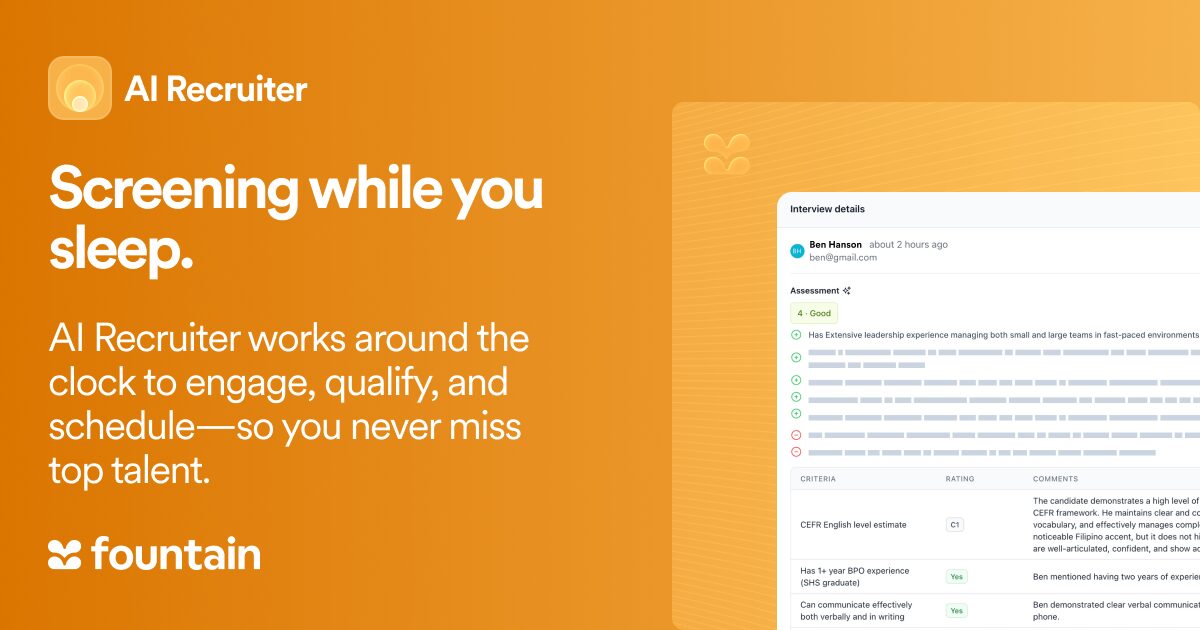
Fountain pairs an orchestration layer with three live agents on top of a frontline hiring and workforce management platform, the combination it calls Frontline Superintelligence. Voice screening runs real phone interviews 24/7, scores candidates against your criteria, and pushes qualified applicants to your team before manual review becomes the bottleneck. A 24/7 candidate support agent answers questions over SMS, voice, and web from application through Day 1 paperwork, and a post-hire engagement agent checks in on new hires to flag retention risk while it’s still actionable.
Key features:
- The orchestration layer turns a plain-English goal, like staffing every shift before a seasonal surge, into coordinated work across sourcing, screening, scheduling, and onboarding.
- Underneath it, ATS, Onboarding, CRM, Sourcing, and Shift & Scheduling run as one system, with native I-9 and E-Verify processing and bi-directional connections to UKG, SAP, ADP, and Workday rather than replacing them.
Proof points:
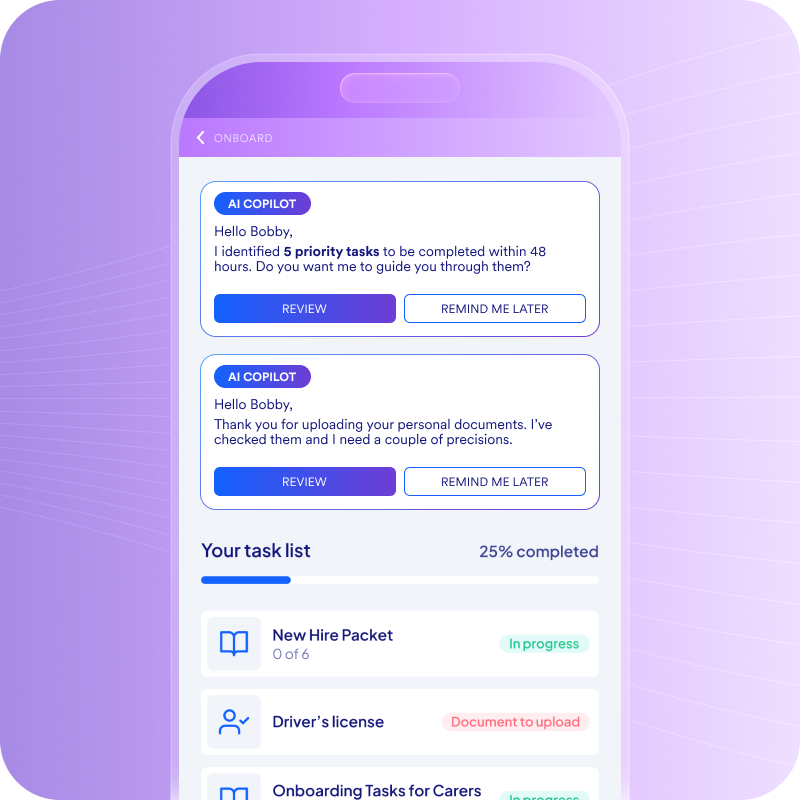
Faster ramp-up. Lower early attrition. AI onboarding built for speed, scale, and retention.
Top employers are already using Fountain’s Frontline OS to:
✅ Reduce turnover in the first 60 days
✅ Eliminate manual paperwork and task delays
✅ Accelerate new hire productivity with smarter workflows
Curious what smarter onboarding could unlock for your team?
- At Fetch, a package-delivery platform, voice screening cut time-to-hire by 95% (15 days to 6.5 hours) and lifted hire rate by 125%.
- At UPS, Fountain compressed time-to-hire to a 7-minute job offer across 125,000 hires in six weeks, while holding the airtight compliance that hiring at that scale demands.
Best for:
High-volume frontline employers in QSR, retail, logistics, and outsourced services filling hundreds to thousands of roles across many locations. Fountain is not the right fit for primarily salaried or knowledge-worker hiring with multi-round interviews, where slower, bespoke evaluation is the operating model rather than the problem.
2. iCIMS
iCIMS added frontline capability through its September 2025 acquisition of Apli, which became its Frontline AI offering inside iCIMS Hire: a conversational candidate experience across SMS, WhatsApp, and web with self-scheduling, plus an API layer connecting to hundreds of partner apps. The suite handles corporate and hourly roles on one platform, a real advantage for teams already standardized on iCIMS.
The catches:
The frontline layer is new and sits on an enterprise TA platform built for requisition-driven hiring, there’s no single named agent orchestrating the work end to end, and buyers with hourly applicants should test mobile completion before assuming the new layer solves legacy friction.
Best for:
Large organizations already running iCIMS for corporate recruiting that want frontline hiring on the same platform, and can absorb the implementation investment.
3. Paradox (Olivia)
Olivia is a conversational agent that screens, schedules, and messages candidates over SMS, WhatsApp, web chat, and email, and it moved inside Workday’s portfolio after Workday completed its acquisition of Paradox in October 2025. Olivia is mature at chat-led screening and gives Workday customers a fast path to conversational engagement, as our Fountain vs. Paradox comparison covers in more depth.
The catches:
Olivia screens for rules and eligibility rather than running a full phone interview, it is not a full ATS, and Paradox’s roadmap now runs through Workday, which matters if you’re on a different HCM.
Best for:
QSR and retail employers on or moving to Workday who want conversational screening and scheduling on top of an existing ATS.
4. SmartRecruiters (SAP SuccessFactors)
SmartRecruiters ships AI sourcing and screening assistants inside an enterprise recruiting motion, and SAP completed its acquisition in September 2025, folding the platform into SAP SuccessFactors. For enterprises already standardized on SAP, that reads as consolidation rather than a new vendor relationship.
The catches:
It was built for knowledge-worker hiring first, mobile and volume workflows feel adapted rather than native, and frontline-heavy buyers should require proof in hourly, multi-location workflows before treating it as a high-volume fit.
Best for:
SAP-centric enterprises consolidating a mixed corporate-and-frontline hiring stack, with high-volume frontline as a secondary use case.
5. Phenom
Phenom spreads more than 30 agents across an enterprise talent experience platform covering career site, CRM, chatbot, and onboarding. That breadth can support hourly workflows, but buyers should confirm which specific agents handle screening, scheduling, and routing rather than treating agent count as a proxy for frontline readiness.
The catches:
The agents serve the broader talent-experience suite rather than a dedicated frontline motion, breadth can mean uneven depth, and conversation quality should be reviewed in your own roles and languages before scaling.
Best for:
Enterprises that prioritize candidate experience and CRM-driven engagement across corporate and hourly populations, wanting a career-site-forward platform.
6. Eightfold AI
Eightfold runs AI Recruiter, AI Interviewer, and Candidate Concierge agents inside a skills-based talent intelligence platform built on a deep-learning skills graph. It’s strongest where the hiring problem is matching skills, rediscovering past applicants, and predicting internal mobility at scale.
The catches:
The use cases center on enterprise, skills-led hiring rather than hourly volume, full value can require significant configuration and change management, and buyers should verify which workflow records stay in the ATS.
Best for:
Large enterprises running skills-based hiring and workforce planning, with high-volume hiring as one use case among broader talent intelligence needs.
7. HireVue
HireVue is a video interviewing and assessment platform focused on the interview stage, not a conversational or orchestration agent, and it works best as a structured evaluation layer inside a broader hiring stack. It offers on-demand and live video interviewing, structured scorecards, and game-based assessments.
The catches:
It requires a separate ATS to run the rest of the funnel, one-way video adds friction for candidates applying from a phone, and it faces regulatory scrutiny under rules like NYC Local Law 144, so review its bias-audit posture before rollout.
Best for:
Large enterprises that need structured, standardized video interviewing for 1,000+ candidates per cycle alongside a full ATS.
8. Harver
Harver is a pre-hire assessment platform built for high-volume and hourly roles, offering an assessment library, pre-built job templates, and mobile-first gamified assessments with realistic job previews. It serves retail, hospitality, contact-center, and logistics hiring.
The catches:
It pairs with a separate ATS rather than replacing one, long assessment flows can hurt completion, and it has no post-hire or onboarding capability of its own.
Best for:
High-volume employers that want a dedicated, validated assessment layer to improve quality of hire, running alongside a full ATS.
9. Hireology
Hireology is a hiring platform for decentralized industries, with centralized applicant tracking, interviews, verifications, onboarding, and text-based application workflows for distributed teams. It’s aimed at automotive dealerships, healthcare facilities, and hospitality franchises.
The catches:
It relies on workflow automation rather than dedicated hiring agents, and it’s narrowly focused on specific verticals, so broad enterprise frontline teams may find the model too specialized.
Best for:
Decentralized, multi-location businesses in automotive, healthcare, and hospitality where local manager adoption is the core operating constraint.
How Fountain runs high-volume hiring
Fountain runs high-volume hiring through Cue, the orchestration layer behind everything above. A regional TA lead can move work in plain English, like “hire 50 drivers across our top 10 markets by Monday, prioritize rehire-eligible candidates,” and every action Cue takes is logged for review.
Anna is the voice screening agent conducting those 24/7 phone interviews, Emma is the candidate support agent clearing paperwork blockers through Day 1, and Sam is the post-hire agent watching for retention risk before it becomes a quit. All three are live, and your team approves every final call.
The agents run on Fountain’s ATS, Onboarding, CRM, Sourcing, and Shift & Scheduling products, natively connected to UKG, ADP, SAP, and Workday rather than replacing them. If you’re filling frontline roles at volume, book a demo to see Cue run a real hiring workflow from application to Day 1.
Frequently asked questions about high-volume hiring platforms
What is a digital staffing platform for high-volume hiring?
It’s software that fills dozens to thousands of positions in a short timeframe, typically in frontline industries like retail, logistics, QSR, and healthcare where demand fluctuates with seasons and growth. That volume is why these platforms differ from corporate ATS tools: they need mobile-first application design, automated screening, bulk operations, and instant scheduling built for cohort hiring rather than one role at a time.
Why do corporate ATS platforms struggle with frontline hiring?
They were built for professional hiring, where one recruiter manages dozens of roles and candidates expect a multi-week process. They use desktop-first, form-heavy applications that drive frontline dropout, process requisitions individually rather than in bulk, and often lack native compliance workflows. Frontline candidates apply on mobile and take the first offer within 24 to 48 hours, so a slow, sequential process loses qualified people before they finish applying.
Should AI make the hiring decision for frontline roles?
No. AI should handle screening, scheduling, and candidate communication so your team makes the final call. A voice screening agent, for example, can screen and score candidates around the clock while recruiters review the results and approve every rejection and offer. Keeping a person in the loop also matters for compliance under rules governing automated employment decision tools.