The technology we built to build Cue, opened to the world.
For ten years, Fountain has done one thing. You describe a job, and we deliver someone who does it. Today we are extending that promise. You still describe the job. Now we can also deliver an agent.
Orchestra is where that happens: where agents are created, where they run, and where you decide what they are allowed to touch.
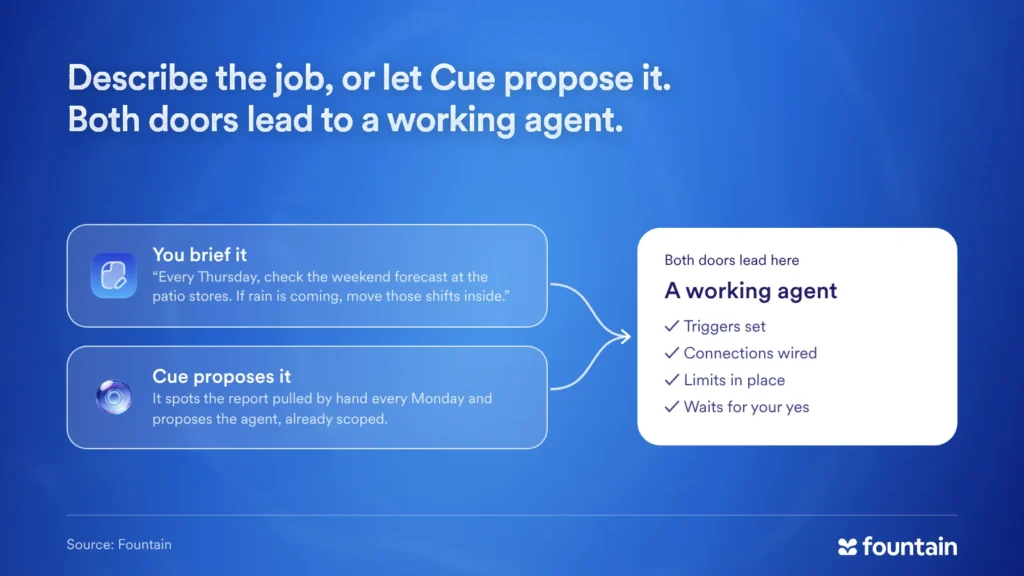
Say what you need the way you would brief a new manager: check the weekend forecast at the patio stores every Thursday, and if rain is coming, pull those shifts and move the people inside where you’ll need them, with the changes on your phone by Friday morning. That is the whole ask. Orchestra comes back with a working agent, its triggers, its connections, and its limits already wired. No canvas of boxes and arrows. No engineer. Describing a job is a skill every operator already has. It is the only one this takes.
And because Cue already watches your operation, you do not even have to ask at all. Orchestra with Cue at its core sees the report pulled by hand every Monday, the follow-up that slips, the question that keeps arriving at two in the morning in a language nobody on your team speaks, and it proposes the agent already scoped and wired. You read the proposal and give the yes. Both doors lead to the same place: agents that fire on triggers, run on schedules, answer on demand, and hand work to each other without anyone wiring the connection by hand. Cadence, the loop underneath, makes every agent sharper with every run and keeps proposing new ones as the operation changes.
Orchestra was never on a roadmap. Building Cue forced us to solve problems nobody had solved for frontline operations: orchestration that lets dozens of agents hand off mid-task, permissions honored at every step so an agent only ever sees what the person running it can see, an evaluation and guardrail layer that runs before anything ships and while it runs, and a connection into every system an operator already uses. We looked for something that did this. Nobody had built it. So we built it, and then customers asked to build on it. Amazon opened the infrastructure it built to run Amazon, and it became AWS. Orchestra is the infrastructure we built to create Cue, opened for the same reason: any operator can now point Cue at a job, a broken process, a rock in their shoe, and get an agent instead of a workaround.
The trust architecture is the one this series already described. Reversible work runs free. Consequential actions wait for a yes. A few decisions stay with a person, permanently, and every action traces back to its origin, whether a human asked for it or Cue proposed it. That same governance runs agents your team builds elsewhere, too. We have spent ten years accountable for workers we do not employ. Agents we did not build are simply new labor, governed the same way.
Cue is already live across hundreds of frontline accounts, and people talk to it like a colleague. Someone typed “Thanks, boss.” Someone else told it “I love you so much rn.” They knew it was software. They said it anyway. That is the interface Orchestra now opens up.
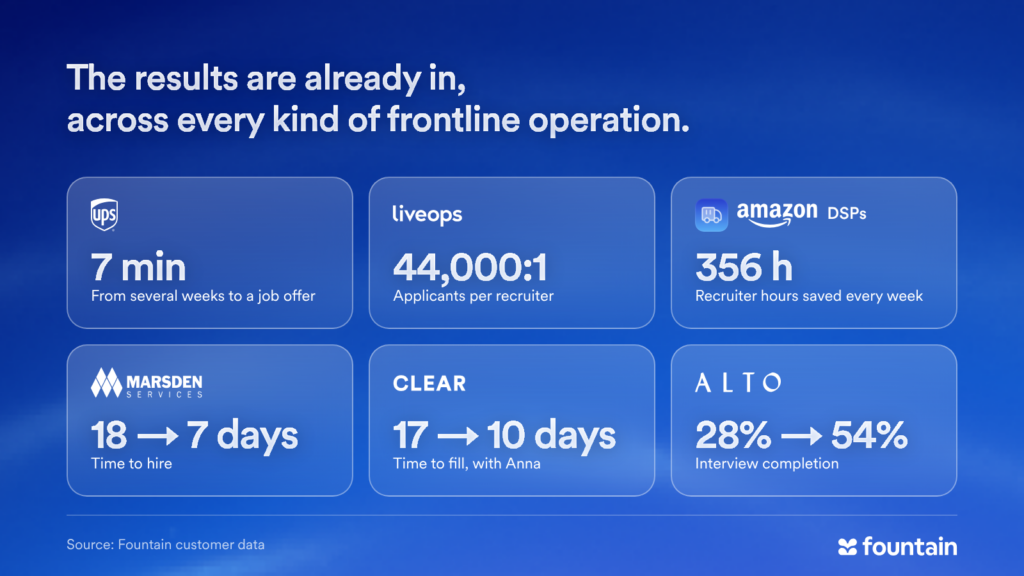
What is real on November 15, stated plainly: building an agent by describing it, seeing the whole thing before it exists, running it on demand or on a schedule, sharing it with your team, and connecting your own systems to it. Two weeks after, agents start firing on events you describe in plain words, unattended, with a spending cap you set and a plain-language readout of what a trigger would have done before you trust it. Later this quarter, agents start handing work to people as well as to each other, in one queue, with write access to records gated by approval. I would rather publish the sequence than pretend it is finished on day one.
Fountain has run on this technology while we built it: roughly 80 agents, every function, every morning, ten times the engineering output with the same team. Ten years ago we set out to staff the frontline. Now we are opening the machine we built to do it.
The system does the work. The human runs the company.
Companion series coming soon. The Operating System Papers.