Frontline hiring runs on a clock most HR tools ignore. Fountain’s research puts the average stretch from application to offer at 27.5 days, and the fastest-moving hourly candidates take the first solid offer they get. Replacing a frontline worker who walks can run into the thousands once recruiting, onboarding, and lost productivity are added up, according to the 2025 Fountain Frontline Report, so every open shift compounds quickly.
Frontline workers make up about 80% of the global workforce, yet most general HR systems still run on salaried recruiting workflows rather than high-volume frontline ones.
A slow process leaves shifts open, pushes existing staff into overtime, and sends candidates to whoever responds first. In frontline hiring, speed is the difference between a covered shift and an empty one.
What is HR automation?
HR automation is technology that runs HR work, from recruiting and onboarding to compliance and employee questions, with little or no manual intervention. For a frontline operation filling hundreds of roles a week, that difference decides whether shifts get covered or burn overtime.
It works in two layers, and knowing which is which tells you what you can actually hand off.
- The first layer is rule-based workflow automation. Predefined “if this, then that” logic where the same condition always triggers the same action. It handles structured, repetitive work well, like routing an applicant to the nearest location, starting an I-9 checklist, or firing a reminder sequence. It doesn’t adapt when circumstances change, and every new scenario needs fresh configuration.
- The second layer is agentic AI. These systems reason, plan, and act across a workflow, with a human approving the calls that matter. Where rule-based automation reacts to a single trigger, agentic systems handle multistep work, read unstructured inputs, and absorb the variable contexts fixed rules can’t.
McKinsey frames the split cleanly: rule-based automation suits repetitive tasks with structured inputs, while AI agents suit multistep decisions with a long tail of variable contexts.
The process redesign comes first. Rethink the end-to-end workflow around what people, agents, and software each do best, because bolting an agent onto a broken process just makes the broken process run faster.
What makes frontline HR automation different
Corporate hiring tools break the moment candidates apply from phones, roles need same-week starts, and a single recruiter is juggling hundreds of openings. Corporate ATS platforms were built for smaller slates of salaried roles on longer cycles. That model buckles when you have to fill hundreds of roles across hundreds of locations and the candidate who hears back first is usually the one you keep.
Most of the friction starts on the applicant side. Frontline applicants often have no work email and no current résumé, and corporate systems tend to assume both. They apply from a phone between shifts, where a long form or an email-only confirmation is easy to miss, so a process built around email quietly screens out the people you are trying to hire.
Candidates notice which employers move fast and reward them, which means a process that answers in minutes beats one that answers in days.
Then there is the structural load. Frontline and hourly roles drive the bulk of high-volume hiring activity, yet many HR teams still run hourly and salaried hiring through the same process. Add availability-based screening, location-specific credentials like CDLs or nursing certifications, and scheduling rules that change by jurisdiction, and a generic system becomes a daily fight.
This is the reality Fountain’s Frontline Superintelligence is built for: applicants are mobile-only, starts happen the same week, and hiring is measured in thousands of roles across hundreds of locations rather than dozens.
The frontline HR processes worth automating
Automate the earliest, most repetitive funnel steps first, because recruiters repeat them hundreds of times a week and candidates drop out while they wait. Some steps belong to automation; others need a recruiter’s judgment. To find your starting point, pull last month’s funnel report, locate the single stage with the longest candidate wait or the steepest drop-off, and automate that one before anything else.
- Sourcing: Multi-channel campaigns put roles in front of candidates faster and cut the manual work at the top of the funnel. Sourcing is where 32% of organizations begin their automation.
- Application and initial screening: This is the most common AI recruiting use case, adopted by 44% of organizations, and the highest-volume manual task you can offload. Knock-out questions, location matching, availability filters, and automated phone screening move qualified candidates forward around the clock.
- Interview scheduling: Scheduling is a notorious drop-off point in high-volume hiring. Self-scheduling links and automated reminders shorten time to interview and keep candidates moving without recruiter back-and-forth.
- Candidate communication: Automated status updates, FAQs, and reminders close the response gap that drives candidate ghosting, so applicants hear something before they give up and take another offer.
- Background-check triggers and onboarding logistics: Increasingly, autonomous agents handle the transactional work between offer and Day 1, the scheduling, background checks, and document collection that otherwise leaves new hires waiting.
Keep recruiters on the work that needs human judgment. SHRM is direct that full automation of HR is neither desired nor practical, so final offers, culture-fit calls, candidate coaching, sensitive conversations, and compliance exceptions stay with people. Automation screens and qualifies around the clock and handles scheduling, reminders, and questions, while your team still owns the final decision.
How automation pays back in faster fills and fewer no-shows
Automation pays for itself when open roles close faster, scheduled hires actually show up on Day 1, and each recruiter handles more candidates without more coordination. Track three numbers to see it: time-to-hire, Day 1 show rate, and active applications per recruiter. Baseline them now, before you automate, so the improvement is provable rather than anecdotal.
Speed is the headline. Bojangles, a quick-service restaurant (QSR) chain with 750 locations across the Southeast, cut time-to-hire from 30 days to 5.8 days after switching to Fountain, an 80% reduction that let it fill roles before competitors scheduled an interview. Fewer days open means fewer uncovered shifts and faster store opens.
The second payoff is fewer no-shows, which protects the candidate you already worked to land. Automated reminders keep new hires warm between offer and start date. After automating manual screening and scheduling steps, Stitch Fix lifted the share of applicants who pass background checks and show up on Day 1 from 68% to 95%, so far more of the people it hired actually started work.
The third payoff is recruiter capacity. When automation absorbs the repetitive coordination, recruiters shift to proactive work. Liveops ran 400,000 applications a year through nine recruiters and hit a 100% fill rate with a 48% reduction in time-to-fill, the kind of leverage that lets you scale hiring without scaling headcount.
Compliance automation for multi-location operations
Compliance automation should enforce the right sequence, track required documents, and flag location-specific risk, while leaving the legal judgment calls to people. For employers running many locations, I-9, E-Verify, and background-check timing are where small, repeatable errors turn into audit exposure. This is general information, not legal advice, so confirm the specifics with your counsel.
A practical first step is to list the required documents, background-check timing rules, and E-Verify obligations for your top five hiring states, then build the workflow to match.
- I-9 timing: Form I-9 Section 1 is due by the employee’s first day and Section 2 within three business days of hire, per USCIS. Because paperwork penalties are assessed per form, one repeated mistake scales across hundreds of hires.
- E-Verify mandates: Requirements vary by state, and a number of states now require E-Verify for all employers while others advance expansion bills, per the National Conference of State Legislatures. A multi-state workflow has to apply the right rule per location, not one rule per company.
- Ban-the-box rules: These laws delay criminal-history questions until after a conditional offer, with lookback windows and timing that differ across Washington, Philadelphia, New York City, and California.
Automated workflows can enforce conditional-offer sequencing before a background check runs, track lookback limits by state, and alert on expiring documents, the kind of centralized tracking that sharply reduces compliance errors.
The EEOC’s individualized assessment and every I-9 exception stay human judgment calls, so the system reduces exposure without removing the review a person still has to do.
How Fountain runs HR automation for frontline teams
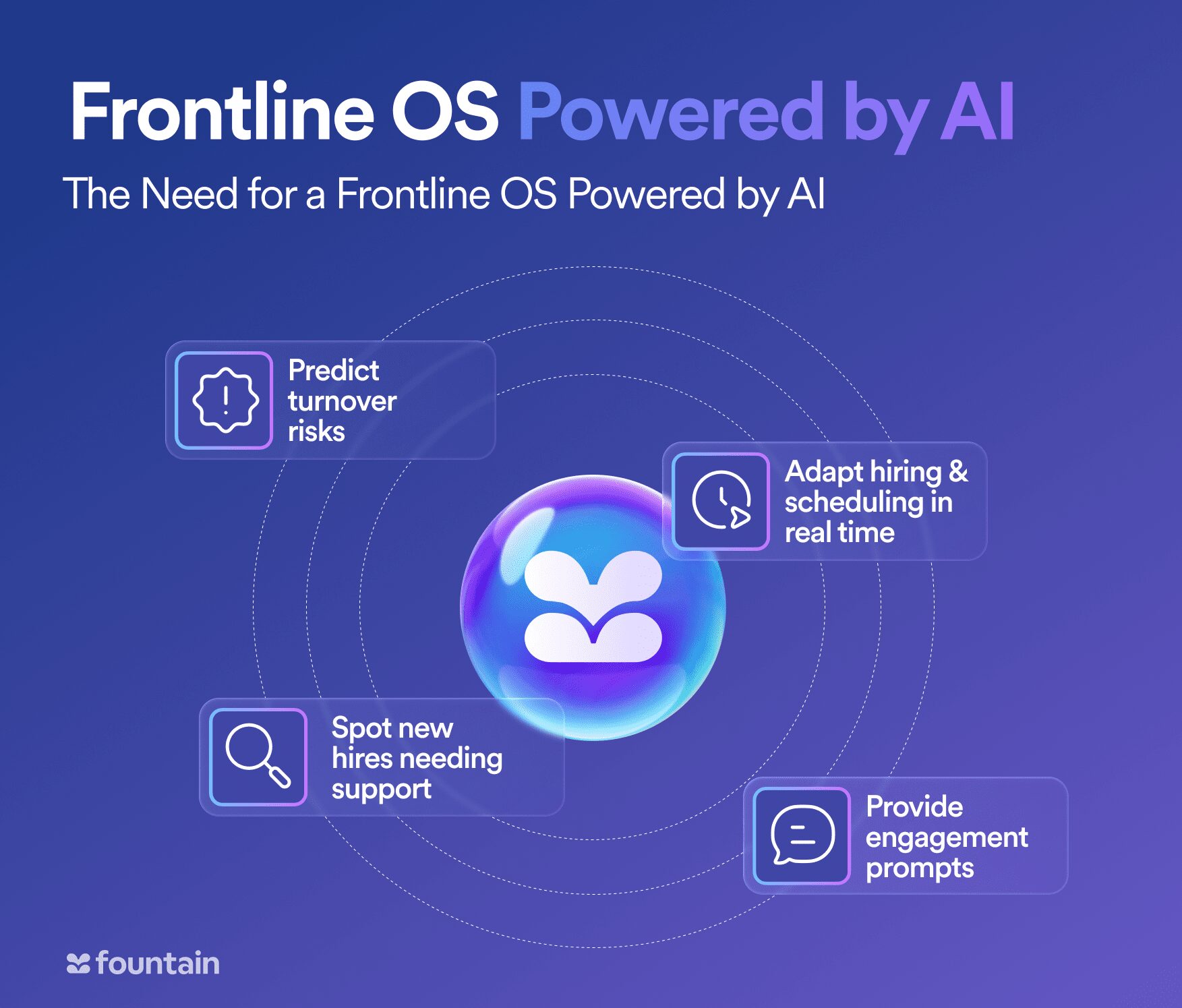
Fountain runs frontline hiring through Cue, the orchestration layer and single entry point to its agents, built into every product. Instead of configuring a market launch across five systems, an operations leader can type a prompt like “Launch hiring in Ventura, CA: build the sourcing plan, onboarding journey, and compliance steps” and get the setup back in minutes rather than months.
Cue builds the plan and keeps the workflow visible to the operations team, with a person reviewing it before recruiters put it to work. Underneath Cue, the agents map to the stages this guide walked through, and the principle is sequencing: automate the repetitive, high-volume stages first, then layer agents onto the multistep decisions.
Anna, the AI Recruiter, runs voice screening and qualifies candidates 24/7 so no one waits for a callback, then hands the final call to your team. Emma, AI 24/7 Support, answers candidate questions, supports Chat Apply, and walks new hires through I-9, W-4, and onboarding paperwork across web, SMS, and WhatsApp. Sam, AI Satisfaction, takes the pulse of new hires through the first 90 days so retention risks surface while you can still act on them.
The agents run on the platform the rest of the guide described. The ATS keeps mobile-only applicants from abandoning a clunky form, with mobile-first applications, automated screening, and self-scheduling. Onboarding gets new hires to Day 1 ready with mobile I-9 completion and E-Verify, and the Integration Center keeps your HCM in sync rather than replacing it.
The payoff is concrete: GoFor consolidated a fragmented driver onboarding process into one flow and cut time-to-onboard from 30 days to 5 days, an 83% reduction, with applicant attrition falling 62%.
That is the shift behind the 27.5-day clock this guide opened with. Recruiters keep the decisions that need judgment, while agentic workflows run the screening, scheduling, reminders, onboarding forms, and compliance tracking that used to leak time and candidates. The result is not a faster broken process; it is a connected one that fills shifts before competitors respond.
See it on a live workflow. Book a demo to watch Cue stand up a market launch, Anna screen candidates by voice, and Onboarding clear I-9s before Day 1.
Frequently asked questions about HR automation
What is HR automation?
HR automation is technology that runs HR work like recruiting, onboarding, and compliance with little or no manual intervention. It operates in two layers: rule-based workflows that follow fixed “if-then” logic, and agentic AI that reasons, plans, and acts across multistep work with a human approving the decisions that matter. The two work together, with rule-based automation handling structured tasks and agents handling the variable ones.
How is frontline HR automation different from regular HR automation?
Frontline candidates apply from phones, often without a résumé or work email, and tend to take the first solid offer they get. Corporate ATS platforms were built for salaried roles on longer cycles and usually assume both a résumé and an email exist. Frontline automation has to handle mobile-only applications, same-week starts, availability-based screening, and location-specific compliance.
Will HR automation replace recruiters?
No. SHRM is direct that full automation of HR is neither desired nor practical. Automation handles screening, scheduling, and messaging so recruiters spend their time on culture-fit judgment, offer conversations, and candidate relationships, less time chasing calendars and more time talking to candidates and managers.