
Frontline hiring runs on a different clock than corporate recruiting. A quick-service restaurant (QSR) manager needs someone to cover next Friday’s shift, not in three weeks. A logistics lead can’t wait out a weeks-long time-to-fill, because every uncovered route turns a recruiting delay into an operational gap. And the candidate who applies from a phone between shifts takes the first offer that moves fast enough, so slow workflows lose people before a recruiter ever opens the application.
The market makes this harder than it should be. Frontline employers make up most of the global workforce, yet research finds that fewer than 25% of companies have cracked scalable frontline recruiting, noting the HR technology market “has struggled to meet their needs.”
In 2026, the first steps of hiring increasingly run through agents rather than forms: screening, scheduling, answering questions, and keeping onboarding moving while a person makes the final call. So the question shifts from which platform has the longest feature list to which agents actually run the work.
This guide profiles nine tools across that spectrum, starting with the platform purpose-built for high-volume hiring, Fountain.
TL;DR: The 9 tools at a glance
- Fountain: High-volume, mobile-first frontline platform; Cue orchestrates agents like Anna while you decide.
- iCIMS: Widely used enterprise ATS with a Frontline AI solution built on its Apli acquisition.
- Paradox (Olivia): Conversational AI for screening and scheduling, acquired by Workday in October 2025.
- SmartRecruiters: Enterprise recruiting platform, acquired by SAP in September 2025 and integrating into SuccessFactors.
- Phenom: Talent experience platform marketing 30+ agents across the funnel, for mid-market and enterprise.
- Eightfold AI: Skills-based talent intelligence for enterprise hiring and internal mobility.
- HireVue: Video interviewing and assessment, best for interview standardization.
- Harver: Assessment-led, simulation-based screening for high-volume selection.
- Workstream: Mobile-first HR, payroll, and hiring for small-to-mid restaurants and hourly teams.
Below, how to evaluate them and where each one fits.
How to evaluate frontline recruitment technology
Corporate ATS criteria don’t transfer cleanly to high-volume hiring. The system that fits a recruiter managing 15 to 20 roles will not fit a team filling 500 roles across 200 locations. Weigh these, starting with the agents that increasingly do the work:
- Agent depth and human oversight: Look for named agents that screen, schedule, and answer candidates, not generic AI bolted onto an older workflow engine, with people approving offers and exceptions.
- Mobile-first application: Test the application from a phone. Most frontline candidates apply on mobile, and long or desktop-bound forms shed many of them before they finish.
- Candidate entry and speed: Text-to-apply, QR codes, WhatsApp, and chat get candidates into the pipeline in minutes, when applicants won’t wait for a desktop-first process.
- Workflow clonability: A corporate ATS builds a new workflow per requisition; a frontline-native platform clones one across hundreds of locations and updates them all at once.
- Integration and compliance: Verify native connectors to your HCM (UKG, SAP, ADP, or Workday) so HR isn’t rekeying data after each hire, and confirm compliance steps like I-9 and E-Verify live inside the workflow.
No tool wins on every line; capabilities vary by plan and implementation, so validate in a pilot.
| Platform | Frontline fit | Named agents (depth) | Best for |
| Fountain | Strong, purpose-built | Cue orchestration plus Anna, Emma, Sam | High-volume frontline at scale |
| iCIMS | Moderate to strong | Frontline AI (no named persona) | Enterprise corporate + frontline |
| Paradox | Strong (overlay) | Olivia (screen and schedule) | QSR, retail, Workday shops |
| SmartRecruiters | Moderate | AI sourcing and screening assistants | Mixed corporate + frontline, SAP shops |
| Phenom | Moderate to strong | 30+ agents (talent experience) | Large-enterprise full funnel |
| Eightfold | Moderate (enterprise) | AI Recruiter, AI Interviewer, Concierge | Skills-based enterprise hiring |
| HireVue | Narrow (interview stage) | Assessment AI (no named persona) | Structured video screening |
| Harver | Retail, logistics, contact centers | Assessment AI (no named persona) | Predictive assessment at scale |
| Workstream | Strong (restaurant focus) | Automation, no named agent | Small-to-mid QSR/hospitality |
9 of the best recruitment technology tools for frontline hiring
1. Fountain
Fountain is the frontline hiring and workforce platform built for high-volume, mobile-first work rather than adapted from corporate recruiting. Its agentic layer runs on Cue, the orchestration layer that coordinates the platform’s agents on top of ATS, Sourcing, CRM, Onboarding, and Shift & Scheduling, with your team making the final call.
Cue is the single entry point across setup, operations, support, and optimization. A hiring leader types a goal in plain language, such as “Hire 10 drivers before Monday,” and Cue coordinates the work, with people approving what matters.
The agents Cue orchestrates:
- Anna runs voice phone screening around the clock. Anna interviews and scores candidates 24/7 and routes the qualified ones to managers for the decision.
- Emma answers candidate questions and clears paperwork. Emma handles Chat Apply and candidate Q&A over SMS, web, and WhatsApp, then walks new hires through I-9 and W-4 paperwork before it stalls a start date.
- Sam tracks post-hire engagement and retention signals. Sam checks in at key milestones and flags early flight risk.
That human-in-the-loop structure matters, because in frontline hiring speed cannot come at the expense of trust.
Underneath the agents, the ATS lets candidates apply from any device with no account, Sourcing runs multi-channel campaigns, CRM re-engages past applicants, Onboarding covers mobile I-9 and E-Verify with a compliance dashboard, and Shift & Scheduling handles coverage with manager approval. Integration Center connects to UKG, SAP, ADP, and Workday.
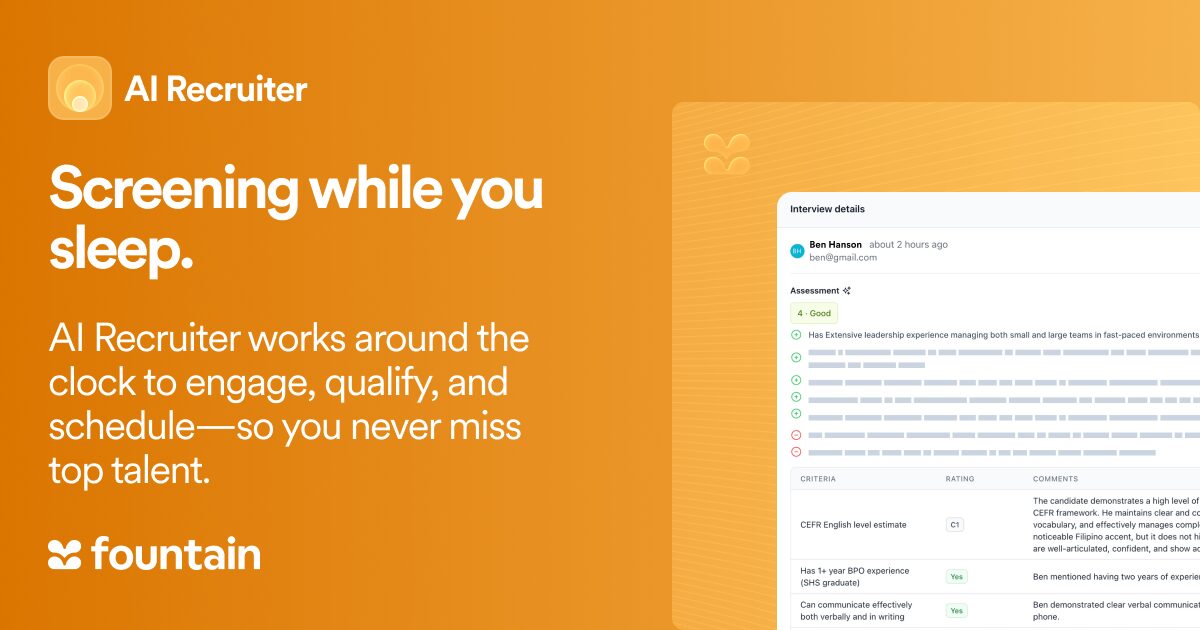
See How Fountain’s AI Recruiter Uses Agentic AI to Cut Screening Time by 79%
Fountain’s AI Recruiter leverages Agentic AI to transform how hiring gets done—screening candidates, scheduling interviews, and surfacing insights automatically. No prompts. No bottlenecks. Just faster, smarter, always-on hiring.
If your team is stretched thin or struggling to keep up with high-volume roles, now’s the time to see what Agentic AI can do.
Fountain customers have reported results such as:
- Fetch, which cut time-to-hire by 95%, from 15 days to 6.5 hours, after adding voice screening.
- Bojangles, which cut time-to-hire by 80%, from 30 days to 5.8 days, across 750 locations.
These are individual customer results rather than guarantees, but they point the same way: faster offers with fewer manual handoffs.
Best fit: High-volume frontline employers in logistics, retail, QSR, healthcare, and outsourced services that fill hundreds or thousands of hourly roles, with mobile applicants and managers who own hiring. Companies hiring mostly corporate roles should use a corporate ATS instead.
2. iCIMS
iCIMS is a widely used enterprise ATS with broad adoption among large, compliance-heavy organizations. Its Frontline AI solution, built on the Apli acquisition, spans SMS, WhatsApp, and web, with no single named agent.
- Strengths: Scales candidate management for large, compliance-heavy enterprises, with deep HRIS integration and strong career-site tools.
- Watch-outs: Frontline AI is a recent addition to an enterprise-first platform and needs knowledgeable administration.
Best for: Large enterprises that want one ATS across corporate and frontline hiring and have the admin capacity to configure it.
3. Paradox (Olivia)
Paradox is a conversational platform built around Olivia, which automates screening, candidate questions, and scheduling over SMS and WhatsApp. It typically sits on top of an existing ATS and was acquired by Workday in October 2025.
- Strengths: Strong conversational experience for mobile candidates; after adopting Olivia, Chipotle reported faster hiring and lifted application completion from 50% to over 85%.
- Watch-outs: Focuses on the early funnel and typically pairs with an existing ATS as the system of record; non-Workday buyers should clarify licensing.
Best for: QSR, retail, and hospitality employers, especially those already on Workday, that want conversational screening and scheduling.
4. SmartRecruiters
SmartRecruiters is an enterprise recruiting platform spanning ATS, CRM, messaging, and analytics with AI sourcing and screening assistants. It was acquired by SAP in September 2025 and is integrating into SuccessFactors, so SAP alignment drives the decision.
- Strengths: Strong enterprise recruiting depth for corporate roles and a natural consolidation fit for SAP shops.
- Watch-outs: Framed by third parties as enterprise and mixed-role rather than frontline-first, and its assistant prioritizes candidates rather than interviewing them.
Best for: Mid-to-large enterprises running both corporate and frontline hiring, especially SAP shops consolidating their stack.
5. Phenom
Phenom is a talent experience platform connecting candidates, recruiters, and managers through agent workflows, and it markets more than 30 agents alongside AI-personalized career sites and a high-volume hiring module.
- Strengths: Among the strongest in the category for career-site personalization and passive-talent engagement, with full-funnel coverage on a unified data model.
- Watch-outs: Feature-heavy with longer implementations and a large-enterprise focus, so map each agent to your funnel breakpoints before treating breadth as depth.
Best for: Large enterprises wanting automation across the full talent lifecycle, with the resources for a longer implementation.
6. Eightfold AI
Eightfold AI is an AI-first talent intelligence platform focused on skills inference, internal mobility, and career forecasting, with AI Recruiter, AI Interviewer, and Candidate Concierge tied to skills-based matching.
- Strengths: Deep skills-inference, strong internal mobility, and well-developed documentation for emerging AI-hiring regulations.
- Watch-outs: Enterprise-only with multi-week implementations, a skills taxonomy that needs upkeep, and reported scrutiny over training-data provenance.
Best for: Large enterprises pursuing skills-based hiring and internal mobility, with the infrastructure for a complex deployment.
7. HireVue
HireVue is a digital interviewing and assessment platform built around structured video interviews and Assessment AI, used at enterprise scale for defensible, standardized evaluation.
- Strengths: Consistent interviews at volume, with a science-backed assessment library suited to campus and financial-services screening.
- Watch-outs: It focuses on the interview stage and typically pairs with a separate ATS, and one-way video can drive drop-off, with about 33% of job seekers abandoning applications that require it.
Best for: Enterprises needing standardized, defensible interview assessment at the top of the funnel, alongside a separate ATS.
8. Harver
Harver is an assessment-led platform using gamified, simulation-based screening, with a large library of assessments and pre-built job templates aimed at retail, contact centers, logistics, and hospitality.
- Strengths: Predictive assessment science aimed at frontline industries, with realistic job previews that can improve retention.
- Watch-outs: Heavy or proctored assessments can reduce completion rates, and it is an assessment layer, not a full ATS.
Best for: High-volume employers where predictive assessment is the primary screening strategy.
9. Workstream
Workstream is a mobile-first HR, payroll, and hiring platform for hourly workers, focused on multi-location restaurants, with text-to-apply, knock-out questions, and self-scheduling. It has no named agents and relies on workflow automation.
- Strengths: Combines hiring, onboarding, payroll, and scheduling in one mobile-first system, with strong restaurant fit.
- Watch-outs: Small-to-mid-market focus rather than the multi-thousand-location tier, with no orchestration layer, and CRM and post-hire engagement are not core.
Best for: QSR, hospitality, and small-to-mid-market operators that want hiring, onboarding, payroll, and scheduling in one place.
Why Fountain is the strongest fit for frontline hiring
For high-volume hiring across logistics, retail, QSR, and outsourced services, where managers own the process and applicants apply from a phone, Fountain was built for that reality: Cue orchestrates the work, Anna screens by voice, and Emma and Sam carry it through onboarding and retention, with your team making the final call.
The honest test for any platform is to apply for one of your own jobs from your phone and count the fields. When hiring is 500 roles across 200 locations, that tells you more than any feature list.
Book a demo to see how Fountain handles mobile-first apply, voice screening, compliance, and HCM integration at volume.
Frequently asked questions about recruitment technology
What is the best recruitment technology for high-volume frontline hiring?
For high-volume frontline hiring across many locations, purpose-built platforms like Fountain are usually the best fit, though the right choice depends on your scale and workforce. They run mobile-first applications, agent-led screening, compliance, and post-hire retention as one system. Enterprise platforms like iCIMS and SmartRecruiters can manage the volume with configuration but were built for corporate recruiting first.
What’s the difference between a frontline-native platform and a corporate ATS?
A corporate ATS is requisition-centric and built for desk-based hiring, creating a new workflow per role. A frontline-native platform is mobile-first, clones one workflow across hundreds of locations, updates them all at once, and builds compliance checks into the hiring flow. The difference shows up in completion rates and time-to-hire at volume.
Does AI make the hiring decision in these platforms?
In well-designed platforms, no. AI handles screening, scheduling, and messaging while humans make the final call. Regulations are tightening around automated hiring decisions in many jurisdictions, so keeping a person in the loop is both best practice and increasingly expected. Just 26% of applicants trust AI to evaluate them fairly, so every score should be explainable and reviewable by a person.
