Labor is one of the largest costs a restaurant carries, and turnover keeps reopening it. Turnover in quick-service and limited-service restaurants runs among the highest of any industry, which makes speed-to-hire one of the biggest cost levers a restaurant has. Replacing a single frontline worker can cost thousands once you add up recruiting, onboarding, and lost productivity, so a mid-sized restaurant running high turnover can shed tens of thousands of dollars a year before anyone has poured a coffee.
The biggest cost-control move is cutting the time and money it takes to hire. Operators reach for AI to compress hiring, cut the manual screening that ties up managers, and stop candidates quitting before Day 1.
The 2026 test: do a tool’s agents screen, book interviews, answer questions, and move new hires toward their first shift without pulling a manager off the line, while leaving the hiring decision with a person?
TL;DR: the 9 tools at a glance
- Fountain: Purpose-built frontline platform for high-volume restaurant hiring, with Cue orchestrating agents that screen, support candidates, and drive retention.
- Paradox (Olivia): Text-based assistant for chat-led applications, screening, and scheduling. Now owned by Workday.
- iCIMS: Enterprise ATS with a new Frontline AI module, built on its Apli acquisition, layered onto a corporate base.
- SmartRecruiters: Enterprise recruiting inside SAP SuccessFactors, with AI sourcing and screening assistants.
- Workstream: Text-first hiring and HCM for franchises; rules-based automation, no named agents.
- HireVue: Video interviewing and AI assessment for structured, repeatable evaluation at volume, not conversational hiring.
- Harver: Pre-employment assessment that plugs into your ATS to screen thousands quickly and lift quality-of-hire.
- Phenom: Talent platform with 30-plus agents across the lifecycle, though none sit behind one orchestrator.
- Eightfold: Talent-intelligence platform using skills-based matching, with AI Recruiter, Interviewer, and Concierge capabilities.
The sections below weigh each tool on agent depth, mobile experience, speed, integrations, and post-hire scope.
How to evaluate AI hiring tools for restaurants
The right tool depends on volume, workforce type, and system connections. Pressure-test six factors, agent depth first, where the real sorting happens.
- Agent depth and human control. An orchestrator that turns “hire 12 cooks by Friday” into a plan beats a chatbot answering one question at a time, and strong QSR deployments keep managers on the final call, as Chipotle does.
- Mobile-first apply. Most applications arrive on phones, and hospitality sees some of the highest mobile application abandonment of any industry; short, sub-five-minute forms complete more often.
- Speed around the clock. Candidates apply outside recruiter hours, and Chipotle sees roughly 30% of scheduling happen after hours, so 24/7 response wins callbacks a slower tool loses.
- HRIS and payroll integration. Many companies struggle to move candidate data into their systems, so native sync with UKG, ADP, Workday, and SAP is a requirement at high volume.
- Post-hire scope. Some tools stop at the interview; others carry the hire through I-9, E-Verify, and shift assignment.
- Volume fit. Enterprise-scale platforms are more than most operations below 100 hires a year need; match the tool to your footprint.
Even a fast apply flow loses candidates when scheduling drags, so treat the funnel as one system.
| Tool | Primary fit | Named agents and depth | Key tradeoff |
| Fountain | High-volume restaurant hiring, many locations | Cue orchestrating Anna (voice screening), Emma (support), Sam (retention) | Built for frontline, not corporate |
| Paradox (Workday) | QSR chat-led apply and scheduling | Olivia: one conversational agent | Now a Workday product |
| iCIMS | Corporate and frontline in one system | Frontline AI (built on Apli); no single named agent | New layer on a corporate base |
| SmartRecruiters (SAP) | SAP-standardized companies | AI sourcing and screening assistants | Knowledge-worker hiring first |
| Workstream | Franchise, multi-location restaurants | No named agent; rules-based automation | SMB-to-mid scale |
| HireVue | Structured, high-volume video evaluation | Assessment AI, not a chat agent | Evaluation, not chat-led hiring |
| Harver | Assessment on an existing ATS | Assessment AI plug-in | Needs another system for Day 1 |
| Phenom | Enterprise full-lifecycle automation | 30-plus agents, no orchestrator | Broad enterprise scope |
| Eightfold | Enterprise skills-based matching | AI Recruiter, Interviewer, Concierge | High-volume agent is new |
Most competitors ship one or two standalone agents, and most stop at the hire.
What are the best AI tools for reducing restaurant operational costs?
1. Fountain
Fountain is the frontline hiring platform built for high-volume, mobile-first restaurant hiring, and it leads with agents rather than another workflow to configure. A manager can tell Cue, the orchestration layer, to “hire 15 line cooks across 8 stores before Friday,” and it breaks that into sourcing, screening, interview slots, and onboarding, with approval gates where needed. Fountain calls this Frontline Superintelligence: intelligence that runs frontline work, not software that reports on it, with people keeping every final hiring decision.
How does Fountain reduce restaurant operating costs?
Fountain cuts cost by screening applicants before a manager steps in, keeping candidates moving, and carrying accepted hires into onboarding and shift readiness. Its voice screening runs 24/7, so nights-and-weekends applicants get qualified immediately, and many frontline workers say they would rather complete an instant AI voice screening than wait for a scheduled callback, according to the 2025 Fountain Frontline Report.
Because the products were built for frontline hiring, not adapted from a corporate ATS, Fountain holds up when you are filling 500 hourly roles and candidates take the first offer that arrives.
Cue is the single entry point to every agent, working in four modes, Setup, Operate, Support, and Optimize, to configure workflows, move candidates, surface funnel and scheduling conflicts, and tune against conversion and time-to-hire, with manager approval throughout.
Re-engage qualified candidates already in your system.
Re-engage high-fit candidates already in your system with Fountain Pool.
Rediscover and rehire faster with a solution built for frontline hiring at scale.
Fountain Pool helps reduce time-to-fill, lower sourcing costs, and eliminate repetitive outreach by making past candidates easy to find, tag, and re-engage. Get ahead of seasonal and high-volume demands by tapping into talent you’ve already vetted. Stop letting strong candidates slip through the cracks and start rediscovering with Pool.
Three named agents handle the recurring work:
- Anna runs first-round voice screening 24/7 and pushes qualified candidates to managers, for the applicant ready to talk now, not after the lunch rush.
- Emma answers candidate questions across SMS and voice from job details to status to interview booking, so no one stalls waiting on a reply.
- Sam captures post-hire sentiment in the first shifts and flags retention risk early, where losing a new hire restarts the replacement-cost cycle.
Together they cover the work a manager would otherwise handle by hand, from first contact to first shift, with the manager still making the hire.
Fountain’s agents run on five connected products that cut handoffs from apply to first shift:
- The ATS anchors high-volume hiring with configurable workflows, automated screening, and self-scheduled interviews
- Sourcing runs job-board, SMS, and paid campaigns
- CRM re-engages past applicants
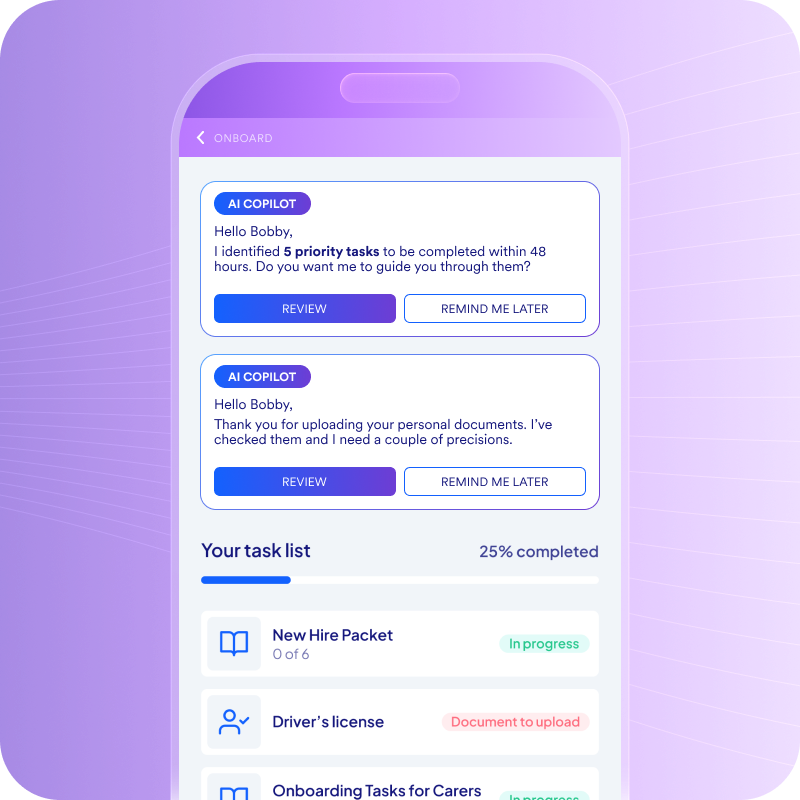
- Onboarding carries hires through I-9, E-Verify, and document collection from their phones, so paperwork does not turn an offer into an unfilled shift
- Shift & Scheduling matches workers to shifts and feeds payroll.
With Fountain, Bojangles, a 750-location QSR chain, cut time-to-hire 80% (30 days to 5.8), reduced job-board spend 86%, and saved roughly 230 recruiting hours in 2022, reaching nearly 30% hire conversion via Text-to-Apply. A leading healthy fast-casual chain across 18 states and 200-plus stores also cut time-to-hire from 14 days to 4, delivered 18.5x more hires, saved 373 interview hours a month, and lifted Day 1 show-ups 39%.
Best for: High-volume restaurant, QSR, and hourly employers filling roles across many locations, without adding recruiters.
2. Paradox
Olivia is Paradox’s single conversational assistant, automating screening, scheduling, and follow-ups over SMS and chat; it powers QSR programs like Chipotle’s “Ava Cado” and McDonald’s “McHire.” Workday completed its acquisition of Paradox on October 1, 2025, and now offers it as part of Workday’s talent-acquisition suite.
Being text-first, it does not judge spoken skills, and some reviewers note Olivia can struggle with off-script questions.
Best for: QSR and franchise operators wanting chat-led apply and fast scheduling on their ATS.
3. iCIMS
iCIMS is an enterprise talent-acquisition platform that added a Frontline AI module to its corporate ATS, bringing screening, multilingual outreach, and workflow automation to frontline hiring. iCIMS built it on its September 2025 acquisition of Apli, a conversational-AI frontline specialist, so the frontline layer is new on an established enterprise base, and it runs through iCIMS Agents rather than a single named persona.
Best for: Enterprise restaurant groups wanting one platform for corporate and frontline hiring.
4. SmartRecruiters
SmartRecruiters, now part of SAP SuccessFactors, runs AI sourcing and screening assistants across the recruiting lifecycle, fitting buyers who want restaurant recruiting inside a broader SAP environment. Built for knowledge-worker hiring first, it ranks applicants rather than running structured interviews.
Best for: Companies standardizing on SAP that want recruiting in a broader HCM stack.
5. Workstream
Workstream is a text-first hiring and HCM platform for franchise and multi-location restaurants, pairing text-to-apply and in-store workflows with onboarding, payroll, and scheduling. It has no named agent, automation is rules-based, and scheduling templates may need manual weekly adjustment.
Best for: Franchise operators wanting hiring, payroll, and scheduling in one text-first platform.
6. HireVue
HireVue is a video-interviewing and AI-assessment platform for structured, repeatable evaluation at volume, and it publishes compliance documentation for the EU AI Act and NYC Local Law 144. It discontinued facial analysis in 2020, and researchers have raised bias questions about speech and biometric scoring, so validate the signals in use.
Best for: Large enterprises running structured, video-based assessment over chat-led hiring.
7. Harver
Harver is a pre-employment assessment platform for high-volume hourly and customer-facing roles, using assessments, job templates, and realistic previews to cut drop-off, and it plugs into major ATS platforms. It is priced for enterprise and does not screen by voice, onboard, or schedule.
Best for: Retail, QSR, and contact-center teams adding assessment to an existing ATS.
8. Phenom
Phenom is a talent platform spanning candidate experience, recruiter workflows, and workforce intelligence, shipping 30-plus agents for applying, assessments, video, and chatbot or SMS scheduling. A late-2025 Frontline Workforce Lifecycle module extends it past hire, but the agents sit across features, not behind one orchestrator.
Best for: Large enterprises wanting one system across career sites, applications, screening, scheduling, onboarding, and mobility.
9. Eightfold
Eightfold is a talent-intelligence platform built on skills-based matching, with AI Recruiter, AI Interviewer, and Candidate Concierge for matching, interviews, and questions across locations. Its high-volume AI Recruiter debuted in August 2025, and matching can weaken for resume-light candidates, so pilot on real hourly profiles first.
Best for: Large enterprises wanting skills-based talent intelligence across the workforce, frontline as one component.
How to choose the right tool for your restaurant
Your workforce, volume, and existing systems decide which tool fits. Work through five questions:
- Size your hiring: a 20-store franchise, a 750-location QSR, and an SAP-standardized enterprise will not buy the same system.
- Name your costliest bottleneck: manager screening time, slow scheduling, unfinished paperwork, and Day 1 no-shows each point to a different tool.
- Match agent depth to it: a full orchestrator suits high-volume, multi-location hiring; Paradox or Workstream fit text-led apply and scheduling on your existing ATS; iCIMS or SmartRecruiters suit a corporate-plus-frontline consolidation; and Harver adds assessment on top of a capable ATS.
- Confirm the integrations: require native two-way sync with UKG, ADP, Workday, or SAP so candidate data moves without manual re-entry.
- Pilot before you commit: test the tool on real hourly candidates, especially where matching or high-volume agents are new.
Frontline turnover and slow hiring draw from the same budget, so weight the tool that closes your most expensive gap, then confirm it in a demo.
How Fountain runs restaurant hiring
Most tools here add AI to software built for another era. Fountain rebuilt the stack for frontline hiring from the ground up, what it calls Frontline Superintelligence. Cue is the orchestration layer: a manager types the goal, and Cue breaks it into sourcing, screening, interviews, and onboarding, with approval gates throughout.
Underneath, Anna screens candidates by voice 24/7, Emma answers their questions across SMS and voice, and Sam checks in after the hire to catch retention risk early, all on top of UKG, ADP, Workday, or SAP rather than replacing them, and with a manager approving every offer.
If your restaurant is ready to compress time-to-hire and close the post-hire gap, Book a demo to see Cue orchestrate Anna, Emma, and Sam on your hiring.
Frequently asked questions about reducing restaurant hiring costs
How long should a restaurant job application take?
Five minutes or less, on a phone. Applications under five minutes complete far more often than longer ones, and short mobile forms draw many more applicants. Candidates apply between shifts, so long forms bleed abandonment.
Do AI hiring tools make the final hiring decision?
In well-designed deployments, no. The agent handles screening, scheduling, reminders, and offer letters; the manager makes the hire. Chipotle built its tool so managers keep final say, and McDonald’s stresses that AI works only when built across people, processes, policy, and data, not on its own.
What’s the difference between a corporate ATS and a frontline hiring platform?
A corporate ATS is built for slower, structured professional hiring, where a recruiter handles 15 to 20 roles over weeks. A frontline platform is built for high-volume, mobile-first hourly hiring measured in hours, with mobile apply, 24/7 screening, scheduling, and onboarding. Several corporate vendors added frontline capability in 2025.