Restaurant operators are buying AI faster than they can prove it works: 73% are investing, but only 5% report measurable value, per Qu’s 2026 technology benchmark. The workforce layer is where that value is easiest to see, because you can judge the tools on two things: how quickly you hire and cover open shifts, and how many manager hours those tasks take.
Who gets hired this week, and whether tonight’s shifts are covered, shows up in ticket times and revenue the same day.
What is AI in restaurant operations?
AI in restaurant operations is software that automates decisions and actions across three layers of the business. Guest-facing AI takes drive-thru orders, answers phones, and personalizes marketing. Back-of-house AI forecasts inventory and runs kitchen production off POS data. In the workforce layer, it screens applicants, builds and fills schedules, and increasingly reads retention signals.
This article covers that workforce layer.
What is actually new there is not the dashboard. It is that the software can act on a staffing signal within limits a manager sets, instead of just displaying the signal and waiting. Agentic screening can run a first interview the moment an application lands, even at 11 p.m., so a candidate who applies Sunday night gets a faster first touch; shift-coverage automation can offer an open shift to qualified staff under rules set in advance.
Hiring and shift coverage hit the same pressure point: managers leave the floor to chase applicants and fill call-outs while turnover keeps shrinking the roster.
Why the workforce layer is where AI can pay off first
AI pays off first in hiring and shift coverage because the manual hours and the churn cost sit in the same place. Food service quits run 4.5% a month, roughly double the all-industry rate, per June 2026 JOLTS data, and annual turnover in quick service routinely runs 100% to 130% or higher.
Most of that churn lands early: 43% of new frontline hires leave within the first 90 days, and replacing one averages $7,000 once recruiting, onboarding, and lost productivity are counted, per the 2025 Fountain Frontline Report.
The tools covering that churn are often the slowest ones on hand. Only 11% of managers use AI-based scheduling, 59% spend 3 or more hours a week building schedules, and 40% still fill open shifts by call or text, per Legion’s 2025 workforce study.
Every one of those manual tasks pulls a manager off the floor at exactly the hours the floor needs them.
How AI automates restaurant hiring
Restaurant candidates apply from a phone and take the first offer that answers, so the first employer to respond usually gets the candidate. Delayed follow-up costs a restaurant otherwise qualified people. If your process takes days to respond, you lose the candidate before you have really read the application.
Agentic screening closes that gap. When an application lands, the system can run a voice interview within minutes, score the answers against the role’s qualifications, and route the strongest candidates to a manager’s phone.
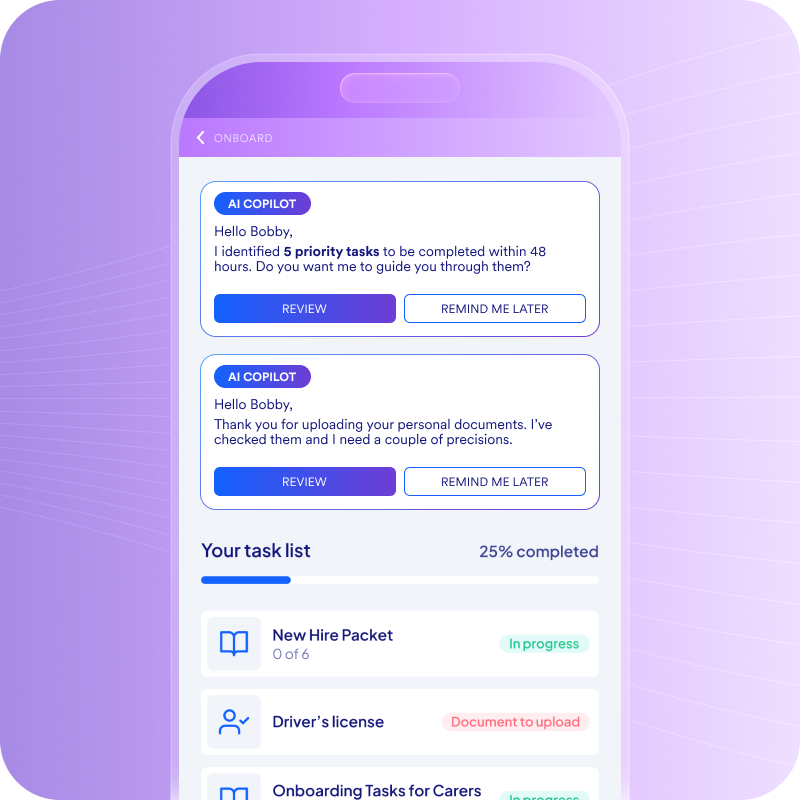
Faster ramp-up. Lower early attrition. AI onboarding built for speed, scale, and retention.
Top employers are already using Fountain’s Frontline OS to:
✅ Reduce turnover in the first 60 days
✅ Eliminate manual paperwork and task delays
✅ Accelerate new hire productivity with smarter workflows
Curious what smarter onboarding could unlock for your team?
Candidates prefer that to waiting: 74% of frontline workers would rather take an immediate AI voice interview than hold out for a scheduled call, per the same 2025 Fountain Frontline Report.
Before: An applicant who arrives Sunday night waits for a manager to get to them.
After: The interview happens on arrival, and only qualified candidates reach the manager’s phone.
Sourcing shifts too. Past applicants and seasonal alumni are already screened and already interested, and their acquisition cost was paid last year, so re-engaging them fills roles without paying job boards for strangers.
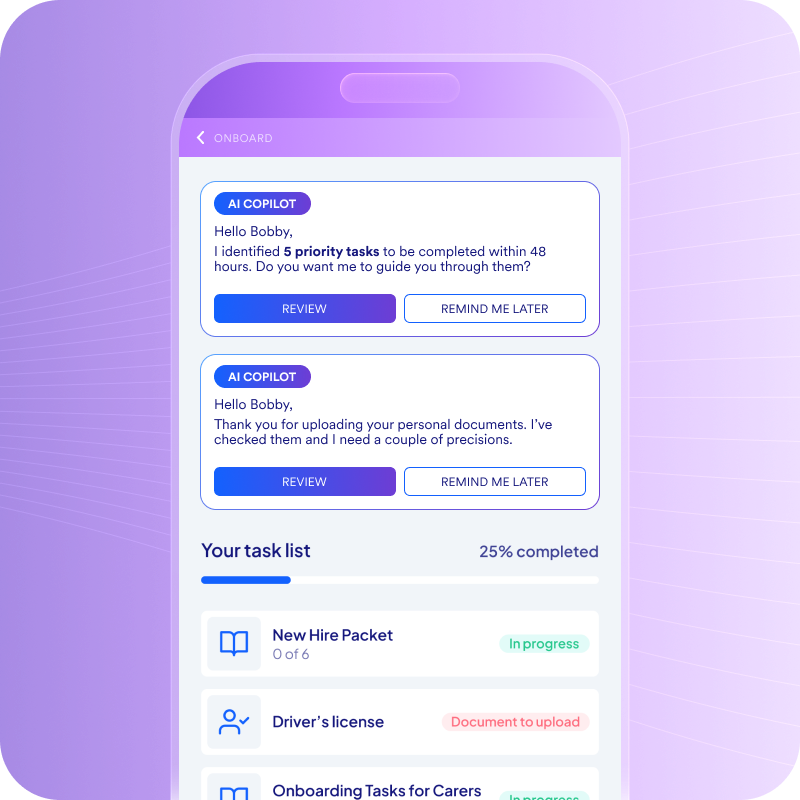
Once a manager extends the offer, agentic onboarding moves the hire through paperwork and document collection from a phone, cutting the time between “yes” and the first shift. The system screens and routes; managers make the offers.
To put it to work, open one high-volume role in your ATS, turn on screening, set three qualification criteria, and lean on a full restaurant recruiting workflow for the roles you fill most.
How AI keeps shifts covered
Shift coverage is the same loop, run continuously. Picture two closers calling out before a Friday dinner rush across three stores: instead of a manager working the phone, the system detects each gap against the published schedule and surfaces replacements filtered by qualification and availability, with the hours each person has already worked that week factored in.
Staff claim or swap the shift from their phones, inside rules a manager sets in advance, so overtime risk and unqualified assignments get flagged before a claim is approved.
Because hiring and scheduling run on one worker record, a hire who cleared onboarding yesterday shows up in today’s coverage pool without anyone rekeying a profile. Set your qualification and overtime rules before you turn on self-service claims, then review the next seven days for gaps.
Before: A manager works the phone after a call-out, one name at a time.
After: Eligible workers see the open shift and the system checks each claim against the rules.
One honest limit: forecasting short-interval demand from POS data is dedicated workforce-management territory. Coverage automation fills known gaps fast, but it does not predict demand in 15-minute blocks, and a hiring platform will not either.
Compliance lands here too, and for restaurants it is on-category. Fair-workweek laws in covered jurisdictions can set rules like advance schedule notice, rest between shifts, and premium pay for late changes, and where they apply, they are easier to hold to when the software checks them as the schedule is built.
Enforcement is real: New York City’s Department of Consumer and Worker Protection secured the $38.9 million Starbucks settlement in December 2025, the largest worker-protection settlement in city history, after its Chipotle settlement set the prior mark in 2022.
Separately, California’s automated-decision rules, effective October 1, 2025, treat AI resume screening and applicant assessments as automated-decision systems and add a four-year record-retention requirement for the employers the state’s civil-rights law covers.
Compliance note: these are examples of how such rules are being enforced, not a determination of what applies to your operation. Whether a given fair-workweek or automated-decision rule reaches your locations, and whether it covers scheduling as well as hiring, depends on the jurisdiction and is still developing.
So, treat this as orientation, not legal advice, and confirm your scheduling and hiring policies with employment counsel.
AI hiring tools vs. AI scheduling tools: Do you need both?
The question under the keyword is whether you need both, and the answer starts with the binding constraint. If open jobs are the problem, start with hiring; if you cannot match available workers to demand, start with scheduling.
Scheduling-first workforce-management platforms lead with POS-connected demand forecasting and labor-cost control and treat hiring as a module; hiring-first platforms run the pipeline from application through onboarding and connect it to coverage. Multi-unit operators can connect both, without paying for two forecasting engines.
The tie-breaker for high-turnover operators is simple: a scheduler alone only redistributes a shortage. One worker record across hiring, onboarding, and scheduling lets a manager close a gap by hiring faster, so the same short-staffed team is not rearranged night after night.
A scheduler rearranges a shrinking roster. One record lets cleared hires refill it.
Three checks decide fit:
- POS and payroll integration tells you whether the system sees real demand and pays people correctly.
- Multi-location visibility tells you whether an area coach can see coverage across units without calling each GM.
- Frontline workers have to test the mobile flow, because if they will not use it, managers revert to group texts.
This piece does not rank vendors; you can read our shift-scheduling software comparison guide to see how major platforms fare against those same checks.
How Fountain runs restaurant hiring and shift coverage
Inside Fountain, Cue is the single entry point, run from plain-English prompts: type “find coverage for this weekend’s call-outs across three locations,” and it surfaces qualified workers and queues outreach for a manager’s approval.
Cue orchestrates three live agents. Anna runs voice screening, Emma clears candidate questions and I-9 and W-4 paperwork, and Sam runs post-hire check-ins that catch flight risk early. A manager approves every decision.
They run on Fountain’s product layer: the ATS, Onboarding, Shift & Scheduling, and CRM. Bojangles, a 750-location QSR, cut time-to-hire 80%, from 30 days to 5.8. That is the difference between spending on AI and proving it works: one record and one approval flow turn hiring and coverage into numbers you watch by the day.
See it on your numbers: book a demo to run Cue, Anna, and Shift & Scheduling against a weekend of your call-outs and an open role.
Frequently asked questions about AI in restaurant operations
Does AI replace restaurant managers?
No. Agentic screening handles repetitive applicant screening, and coverage automation drafts and fills schedules, while managers keep the offer decisions and the schedule approvals. In practice it moves manager time off admin work and back toward guests and coaching.
Can AI predict restaurant staffing needs?
Only partly. Coverage automation can detect and fill known gaps fast, but predicting demand in 15-minute increments from POS data is dedicated workforce-management territory, and its accuracy depends on clean historical data. A hiring platform will detect coverage gaps; it will not forecast interval-level demand.
What’s the difference between AI hiring tools and AI scheduling software?
Hiring tools manage the application-to-first-shift pipeline. Scheduling software builds and adjusts schedules, fills open shifts, and enforces labor rules. High-turnover operators usually need the two connected, since a persistent scheduling problem often traces back to a hiring one.