Over the course of this year, 21 states will be increasing their minimum wages. While this is great news for minimum wage earners, this leaves small businesses unsure of possible long-term effects and greater implications. While analysts are closely examining the impact of raising minimum wage on small businesses, there are important factors to consider beyond the quick math of how much more they have to pay their hourly employees.
How does raising the minimum wage hurt small businesses?
Small businesses that employ a lean, primarily hourly staff, for example, will see impacts on margins and cash flow from the shifts in minimum wage requirements. For those predicting a big hit on their bottom line, the big question is if they should make any changes to make up for it. Our answer to that is an emphatic yes!

Small businesses minimum wage hikes mean small business owners need to take control r by changing hiring methods to offset these new payroll costs.
Small business minimum wage and your businesses?
There is an ongoing debate about the impact of raising minimum wage on small businesses. Even with countless laws passed and economic studies conducted, there continues to be no consensus on the effects of raising minimum wage for small businesses and being able to answer questions like: Do rate hikes cut job hours? Hurt small businesses? Boost consumer spending? Cause prices to rise?
Some studies find little to no effect of raising minimum wage on small businesses, while others see a significant effect. A study recently published in the American Economic Review provides new evidence that increases in the minimum wage reduce employment in the long run.

Minimum Wage and Small Business Owners
If you talk to small business owners, the topic of rising minimum wages is like a pressure cooker. Raising minimum wage for small businesses mean higher payroll costs. When you couple this with the price hikes materials for store inventory, small businesses feel the pressure two-fold. Unlike larger companies who can afford to replace workers with technology investments, small businesses don’t have this option. As a result, every penny that goes into hiring operational costs is crucial to the health of small businesses.
Keep reading to the end to get our recommendations for offsetting wage increases on your overall operational costs. It’s a lot easier and inexpensive than you think!

Franchises: How does minimum wage affect a business
For franchises, this issue raises an interesting grey area. In Seattle, for example, the legislation considers independently operated franchisees as ‘large employers’ because they contract with a brand, and subsequently forces them to implement the increase faster than local, non-franchise businesses. On the other hand, some franchisees have benefited from corporate investments in technology which reduce the need for as many workers. One example is with the introduction of ordering kiosks at McDonald’s which replace the need for cashiers. The hope is that this will help curb long-term costs in workforce by winning back $2.7 billion in sales.

Fountain Lite – free hiring solution for small businesses and family-owned franchises

Large Enterprises: How does minimum wage affect a business
Similar to franchises, larger retailers like Target and Walmart started implementing automatic solutions like self-checkouts during the 2018 holiday season. While this has been marketed as a way for cutting the time spent in check out lines, it also replaces minimum wage employees by eliminating the need for traditional cashiers.
Since larger corporations have larger budgets, they can afford to implement more cost-cutting technology. While we typically think of technology being introduced to increase the efficiency of workers, we are now seeing automation that eliminates certain jobs altogether. While cashiers may become less crucial to operations, however, these innovations have also opened up new positions. Target, for example, has made a bigger push for self checkouts but they have also made an even bigger push in their same day delivery service with Shipt. This introduces more delivery driver jobs to the job market that didn’t previously exist. How the minimum wage increase effects this new business venture remains up to debate.
How large companies are hiring in today’s changing landscape. Get the Modern Hiring Guide.
Minimum wage increases by state and their impact on small business owners
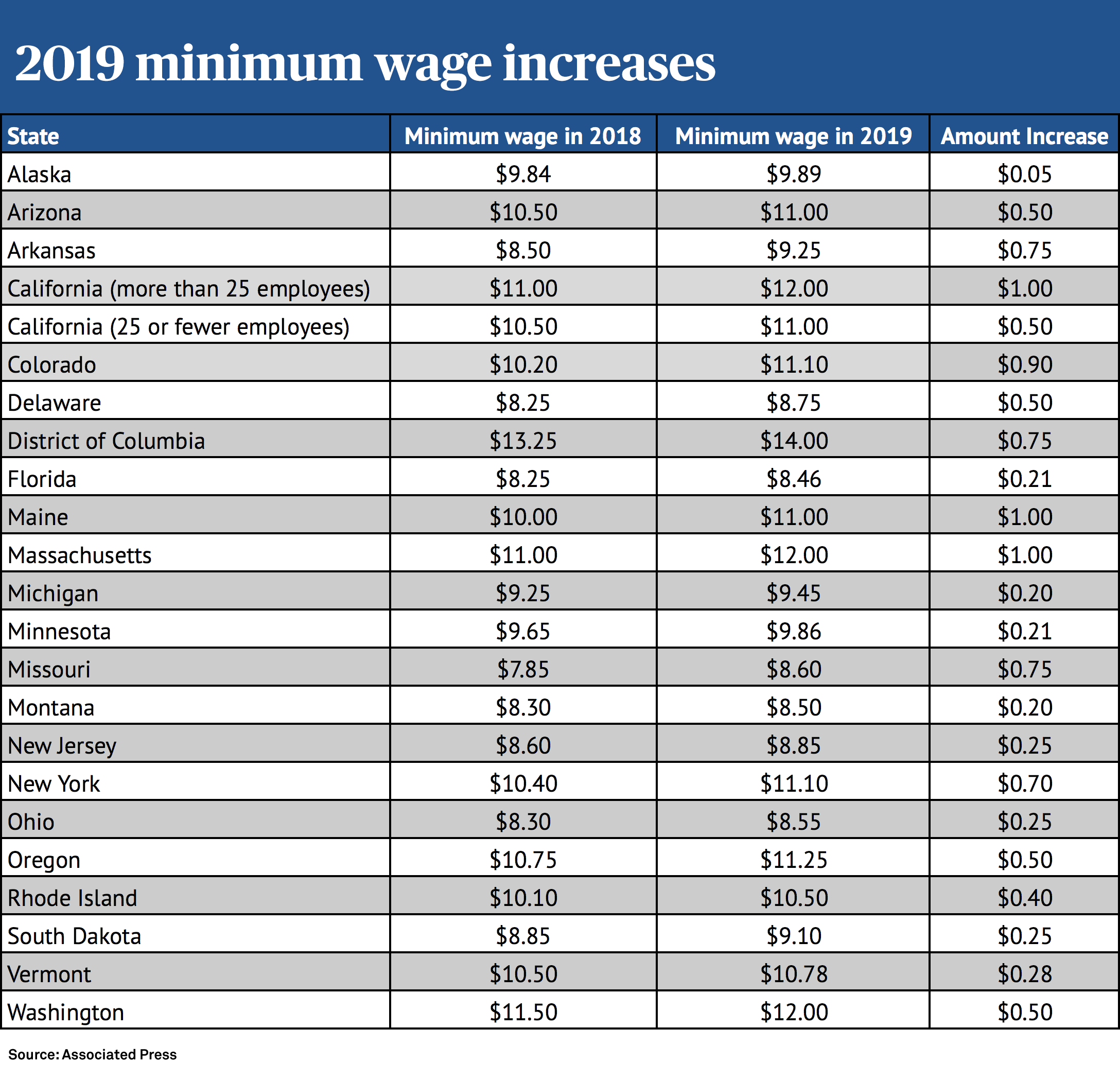
Some of the hikes are part of laws that require wages to increase progressively each year. In California, for example, the minimum wage is set to reach $15 per hour by 2023 for businesses with more than 25 employees. Washington state, on the other hand, passed a law that boosts its minimum wage to $12 this year and $13.50 in 2020.
Here’s a state by state look:
A closer look…
- $12.00 rate is for California employers with 26 or more employees. Employers in California with 25 or less employees have a minimum wage of $11.00 per hour.
- $9.86 rate is for large employers. Small employers have a minimum wage of $8.04 per hour.
- $7.25 rate is for Nevada employees who are offered health insurance. $8.25 rate is for Nevada employees who are not offered health insurance.
- Statewide minimum wages apply in areas that are not governed by a higher, local minimum wage ordinance. New York City and Portland Metro are examples of areas which have local minimum wage rates that exceed the statewide minimum.
The reason for wage hikes now, and the impact of raising minimum wage on small businesses
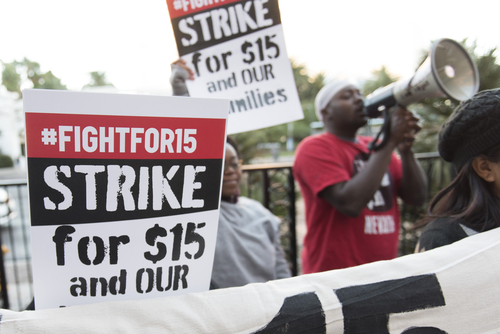
In 2012, the “Fight for $15 movement” began after fast-food workers began walking off the job demanding for higher pay. Since then, advocates in the national “Fight for $15” movement have pushed for living wages for fast-food, child-care, airline and other low-wage workers, and have been successful in some cities and states. It is believed that this movement directly led to a collective $68 billion raise for 22 million low-wage workers in both the public and private sectors.
Opponents of minimum wage increases – like the D.C. restaurateurs who campaigned against higher wages for tipped workers – typically argue that extra expenses will force fire workers or even close, harming employers and employees alike. More research is necessary, but right now there’s no conclusive proof that a higher minimum wage leads to significant job losses.
Minimum wage and small business owners – reduce cost where it counts
So where does this leave business owners caught in the middle? The debate is still ongoing and divisive. Even with all the studies conducted, trying to measure the impacts of raising minimum wage on small businesses and the U.S. economy have conflicting conclusions.
For this reason, it’s important that businesses focus on the things within their control. If you are a business owner in one the of states implementing wage hikes, you can out-maneuver payroll and inflation by reducing recruiting and and hiring costs. Typically, businesses spend $4000 and up to 52 days trying to fill an open position. For small businesses, this means that every hour you spend focused on hiring, you are not focused on running your business and making profit.

We recommend that if you are spending more than 40% of your working hours on hiring, you should use hiring automation instead. This increases both your hiring efforts while also reducing your operational costs. And when you reduce costs, you can offset things like payroll and inflation.
Using hiring software doesn’t have to be expensive or labor-intensive. In fact, you can get hiring software for free and start posting unlimited jobs to free job boards immediately. Hiring automation is no longer just for large enterprises. Small businesses are benefiting from this technology as it saves them invaluable time and increases the number of qualified applicants responding to their job postings. Now more than ever, there are options for small businesses and more ways you can take back control over your operational costs.