A high-volume hiring process has to absorb its volume at a cost the business can defend. For frontline teams, that cost surfaces every time the same role opens again.
Frontline turnover makes every re-fill a recurring cost. In 2025, BLS put total separations in accommodation and food services at 5.5 percent, the highest among major industry sectors, with retail trade at 3.8 percent and transportation, warehousing, and utilities at 4.0 percent. At those replacement rates, every decision about how a role gets filled compounds hundreds of times a quarter.
Two failure modes trap high-volume teams. Teams that lean on agencies see per-hire fees stack up with every replacement cycle. Teams that go in-house without the tooling to process applicants at frontline speed lose candidates to ghosting before Day 1.
For recurring frontline roles, the economics favor owned infrastructure over per-placement fees, but only when the in-house process can move at the speed frontline candidates decide.
What is a recruiting agency, and what does it actually do?
A recruiting agency sources and screens candidates, then places them on an employer’s behalf. The employer defines the role, the agency finds and vets people, and the employer makes the final hiring call. That core function holds across every agency type.
The three agency models differ mostly in how they charge and what they’re built for.
- Contingency: Contingency agencies are paid a percentage of the hire’s first-year compensation, but only when a placement is made. No hire, no fee. SHRM places contingency fees at 20 to 25 percent of total first-year cash compensation, most often for mid-level roles. A repeat replacement restarts a fee tied to annual compensation, not to the recruiting effort involved.
- Retained: Retained search firms are paid partly upfront through an exclusive engagement, with the balance split across milestones. SHRM pegs retained search fees at around 33 percent of first-year compensation. Because the cost is committed before the hire is complete, retained search belongs on scarce senior or hard-to-fill searches.
- Temp and staffing agencies: Temp and staffing agencies are paid an hourly markup on each worker’s pay rate. The agency is the employer of record and handles payroll, taxes, and workers’ comp. This is the common model for temporary or contract frontline coverage.
Traditional agency models suit less frequent hiring better than recurring frontline hiring. The billing structure, the guarantee windows, the sequential screening: all of it works better when hiring is an occasional event, not a daily operation.
The real cost of using a recruiting agency
Agency economics are built around occasional placements, so cost scales with hiring volume. Every additional placement generates a new invoice. That math works when a role gets filled twice a year. It breaks when the same role gets filled fifty times a month.
Start with the temp markup model, since that’s what many frontline teams evaluate first. Take a warehouse worker at $18 an hour with a 40 percent markup. The bill rate becomes $25.20 an hour. Over a 12-week assignment at 40 hours a week, that’s $12,096 per worker against $8,640 in actual wages. The agency spread is $3,456 for a single hire.
Now scale it. Staffing 100 warehouse workers on those same terms produces $1,209,600 in total bill cost against $864,000 in pay cost. The agency spread reaches $345,600 on one 12-week cycle. Warehouse and manufacturing roles add training demands and administrative work on top of the bill rate. Markup and pay rates vary by market and contract, so treat these figures as an illustration of the pattern, not a quote.
Cost check: one 12-week, 100-worker cycle creates $345,600 in agency spread before the next replacement cycle begins.
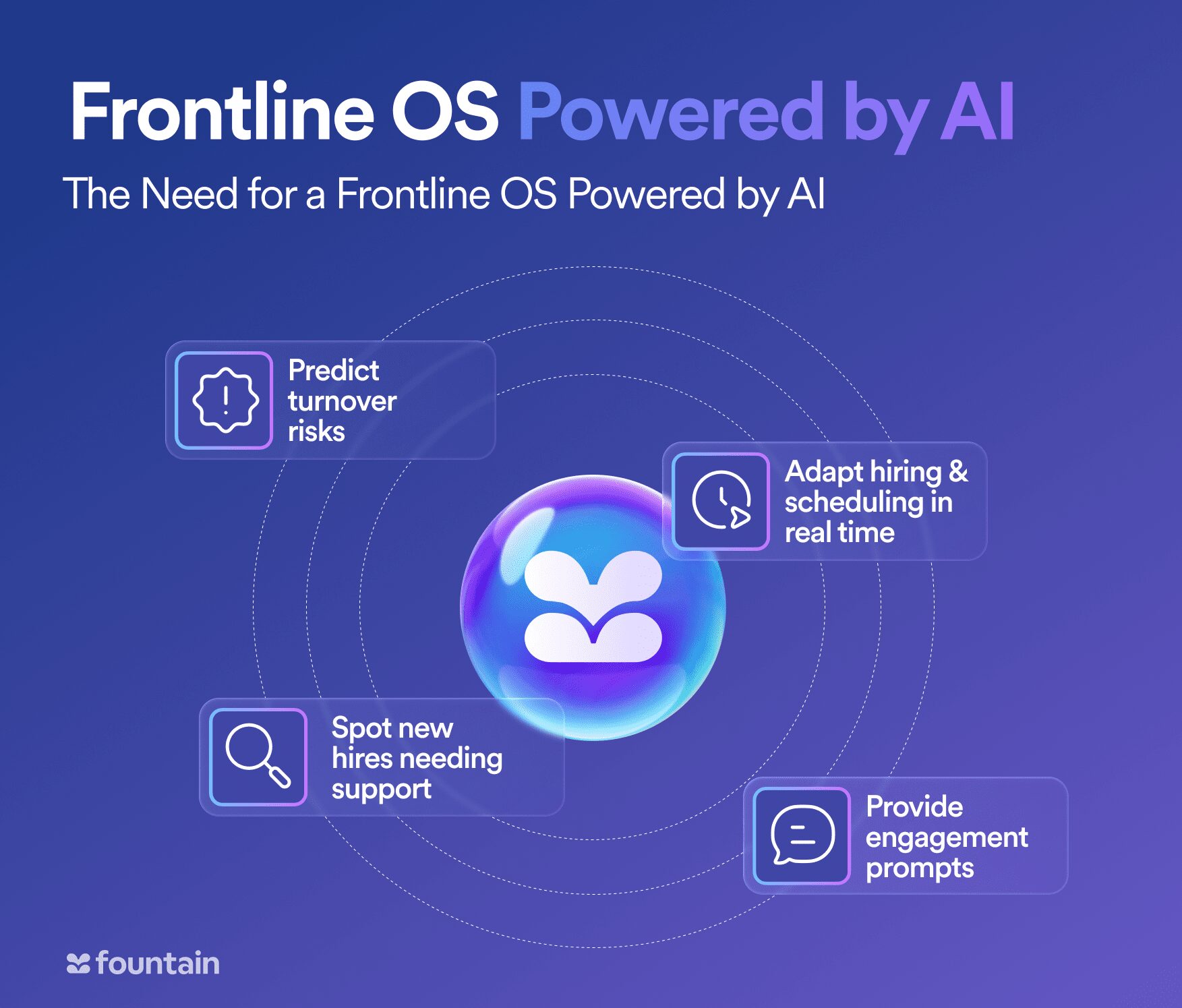
A smarter, connected way to hire, engage, and retain frontline teams
Centralize scheduling, hiring, onboarding, engagement, and analytics in one AI-powered platform built for the frontline workforce. Fountain OS gives leaders the real-time insights and tools they need to predict turnover, boost retention, and streamline high-volume operations.
Automate repetitive tasks, identify at-risk employees early, and make data-driven workforce decisions with a unified solution designed to help frontline teams thrive.
The costs that never show up on the invoice matter just as much. Someone briefs the agency on each role and manages the guarantee terms. When a placement falls through, the internal team absorbs the re-briefing, the re-interviewing, and the vacancy gap. Fountain’s Frontline Report puts a single frontline replacement at roughly $7,000, so those repeated cycles get expensive fast.
When a recruiting agency actually makes sense
Recruiting agencies earn their fee for niche or senior roles, one-off hiring spikes, and teams that have no in-house recruiting capacity yet. Three cases hold up.
- Niche, senior, or hard-to-fill roles. Agencies are strongest for senior staff posts and high-demand specialist positions. A general in-house recruiter posting to job boards reaches active job seekers. A specialized agency reaches passive candidates internal sourcing can’t. For a frontline operation, that means an above-the-line hire like a store manager or an operations lead.
- One-off or infrequent hiring spikes. Ramping for a holiday rush or covering parental leave without building permanent capability is where agency flexibility pays off. A permanent in-house recruiting function carries ongoing cost. When hiring comes in unpredictable bursts, variable agency cost is easier to defend than fixed internal cost.
- No in-house recruiting function yet. A very early-stage company that hasn’t built job board access, recruiting tooling, or recruiting expertise can use agency help as a bridge until it does.
None of these describe a high-volume frontline operation running repeat frontline hiring. When the same roles open every month, every resignation triggers another agency fee.
When a recruiting agency is the wrong tool
For repeat, high-volume frontline hiring, the agency model works against the operation at nearly every step. Each feature that made sense for occasional placements becomes a cost multiplier.
- Recurring fees at frontline turnover rates. Per-placement and per-markup billing recurs every cycle. With separations elevated across retail, food service, and transportation and warehousing, you pay to fill the same seat again and again.
- Speed mismatch. Frontline candidates decide fast, and an agency adds a handoff layer to a process where speed is the whole game. According to Fountain’s Frontline Report 2025, 57 percent of candidates cite slow hiring as a top frustration, so every extra handoff raises the odds that applicants ghost, accept another offer, or never reach Day 1.
- Employer brand control. When an agency intermediates, it controls how candidates first experience the company. Poor agency behavior toward candidates it deems unqualified can lead those candidates to blame the employer whose role they applied for.
- No data to improve the funnel. High-volume hiring usually breaks at the process level. Manual screening buckles across hundreds of simultaneous hires, and agencies working outside your tech stack leave no funnel data to act on.
The gap comes from a slow ATS and manual screening. The agency model can’t move at frontline speed or hold cost flat across volume. Every handoff costs time. Every re-fill costs money.
The alternative: in-house hiring with the right infrastructure
In-house hiring works when the infrastructure does the heavy lifting. Four capabilities make it viable at frontline volume:
- A frontline-specific applicant tracking system moves every applicant through the funnel automatically.
- Anna runs first-pass phone screens and voice interviews across large applicant pools, then routes qualified candidates to a manager for the final call.
- Mobile-first apply flows and self-scheduled interviews cut the friction that makes candidates drop.
- Automated outreach over SMS, email, and WhatsApp keeps candidates warm between steps.
Human oversight stays central. Automation screens applicants, routes them to the right role, and recommends next steps, while managers approve offers and handle the exceptions.
Teams moving in-house start with one recurring frontline role and build its apply-to-offer workflow in Fountain’s ATS before scaling to the rest. Before, recruiters screen and chase each applicant by hand. After, the system advances qualified candidates automatically and recruiters spend their time on exceptions.
The economics separate the two models. Every agency placement triggers another fee, while owned software spreads its fixed cost across more hires, so internal cost per hire keeps falling as volume grows.
How to decide: a practical framework
The choice between an agency, in-house hiring, or a hybrid model comes down to hiring volume, turnover frequency, and whether the team has the tools to move candidates quickly. Three questions settle most cases.
- How many hires per quarter? Dozens or hundreds pushes past the point where per-placement fees are easy to defend.
- How often do these roles turn over? High churn means constant re-filling, and every re-fill restarts the fee clock.
- Can the process move at candidate speed? If apply-to-offer runs slower than candidates expect, volume alone won’t fix it.
The matrix below maps role type against hiring frequency and in-house capability.
| Role type | Hiring frequency | In-house capability | Recommendation |
| Frontline hourly | High / recurring | Has frontline tooling | In-house plus software |
| Frontline hourly | High / recurring | No tooling yet | Hybrid, then build in-house |
| Frontline hourly | One-off spike | Any | Agency (temp/staffing) |
| Senior / specialized | Infrequent | Any | Agency (contingency/retained) |
| Mixed | Consistent | Full-cycle team | Hybrid |
Read it starting with volume and frequency. For recurring high-volume frontline roles, in-house hiring with tooling wins. Reserve agencies for one-off spikes and senior or specialized searches.
Teams that export last quarter’s hires by role and tag each as agency, in-house, or hybrid can see which recurring roles belong in an automated workflow and which rare roles still justify agency spend. Before, the team debates agency use by anecdote. After, the decision runs on data.
Where Fountain fits for high-volume frontline teams
Fountain, the AI-native platform for the global frontline workforce, runs sourcing, screening, and onboarding in one pipeline, with support for I-9 workflows and audit-ready documentation, instead of charging an agency fee for each placement. Its Frontline Superintelligence is built for the daily operation of frontline hiring. Cue gives recruiters a single entry point: type an operating prompt like “Hire 200 warehouse associates before peak,” and Cue orchestrates the pipeline behind it. At that volume, orchestration is what keeps manual handoffs from becoming the bottleneck that delays Day 1.
Anna runs first-pass phone screens and voice interviews around the clock, then routes qualified candidates to managers for the final call. Overnight and weekend applicants move forward before manager availability becomes the constraint. Fountain Onboarding guides workers through I-9 and W-4 paperwork and keeps audit-ready records.
For an agency-filled frontline role, mapping its apply-to-Day 1 steps in one pipeline changes the pattern. Instead of each replacement triggering a new agency handoff and fee, Cue coordinates applicants from screening through onboarding and I-9 documentation in one owned workflow.
The same shift shows up across delivery and quick-service operators. Fountain’s UPS case study reports 100,000 workers hired in six weeks. Fountain’s Fetch case study documents a 95 percent cut in time-to-hire, from 15 days to 6.5 hours, with Anna running screening. Per that same case study, the three-person Driver Operations team now manages more than 10,000 monthly applicants, throughput that would otherwise demand far more recruiting headcount. Fountain’s Bojangles case study shows time-to-hire down 80 percent, from 30 days to 5.8 days across 750 locations, with job board spending down 86 percent. All three moved manual hiring steps into Fountain so recruiters could process more applicants without adding headcount.
The warehouse math makes the contrast concrete. One 12-week cycle of 100 workers hands the agency $345,600 in spread, while running that pipeline in-house replaces repeated placement fees with software cost divided across every hire.
Book a demo to see how Cue runs sourcing, screening, and onboarding at the speed frontline candidates decide.
Frequently asked questions about recruiting agencies
Recruiting agencies are most useful when the role type, hiring frequency, cost model, and internal recruiting capacity justify paying for outside support.
How much do recruiting agencies charge?
Recruiting agency costs vary by model. Contingency recruiters charge a percentage of first-year compensation, temp agencies charge an hourly markup, and retained search firms charge higher milestone-based fees for senior roles. Per SHRM, contingency fees commonly run 20 to 25 percent of a hire’s total first-year cash compensation, which works for occasional mid-level searches but becomes hard to defend when the same role turns over repeatedly. Temp and staffing markups vary with role, market, insurance costs, payroll taxes, and contract terms. SHRM puts retained search at around 33 percent of first-year compensation, reserved for senior or specialized roles where scarcity justifies the cost.
What’s the difference between a staffing agency and a recruiting agency?
A staffing agency supplies temporary workers and stays the employer of record, while a recruiting agency sources candidates for permanent roles you employ directly. Staffing covers temporary and contract needs. Recruiting covers permanent placements.
Is it worth using a recruiting agency for frontline workers?
For repeat, high-volume frontline hiring, usually not. Per-placement and markup fees recur with every hire, and with elevated separations in frontline-heavy sectors, those fees compound fast. At recurring volumes, in-house recruiting with software scales more easily because the infrastructure cost spreads across more hires.
When should I use a recruiting agency instead of hiring in-house?
Reach for an agency on niche or senior roles where its network finds passive candidates internal sourcing can’t, on one-off hiring spikes where building internal capability isn’t worth it, or when there’s no in-house recruiting function yet. For high-volume, recurring, predictable hiring, in-house infrastructure is the stronger choice.