Retail faces the highest frontline workforce churn of any major industry. The 2025 Fountain Frontline Report puts annual retail turnover at 60%, and replacing a single frontline worker costs $6,500 to $7,000, roughly 40% of their annual pay. This means that a 500-store chain cycling through thousands of associates annually is spending millions just to keep roles filled.
That’s the problem AI agents in retail solve. Not by flagging the shortage, but by screening candidates, scheduling interviews, and covering shifts before a manager has to intervene.
This article breaks down what AI agents do in retail, where they deliver measurable results, the compliance guardrails required to deploy them, and how to phase them across store locations without disrupting operations.
What are AI agents in retail?
AI agents in retail are systems that act on hiring and scheduling across store locations without waiting for a human to initiate each step. In an industry where turnover runs at 60%, seasonal demand can double headcount needs in weeks, and candidates are choosing between employers the same day they apply, that speed matters.
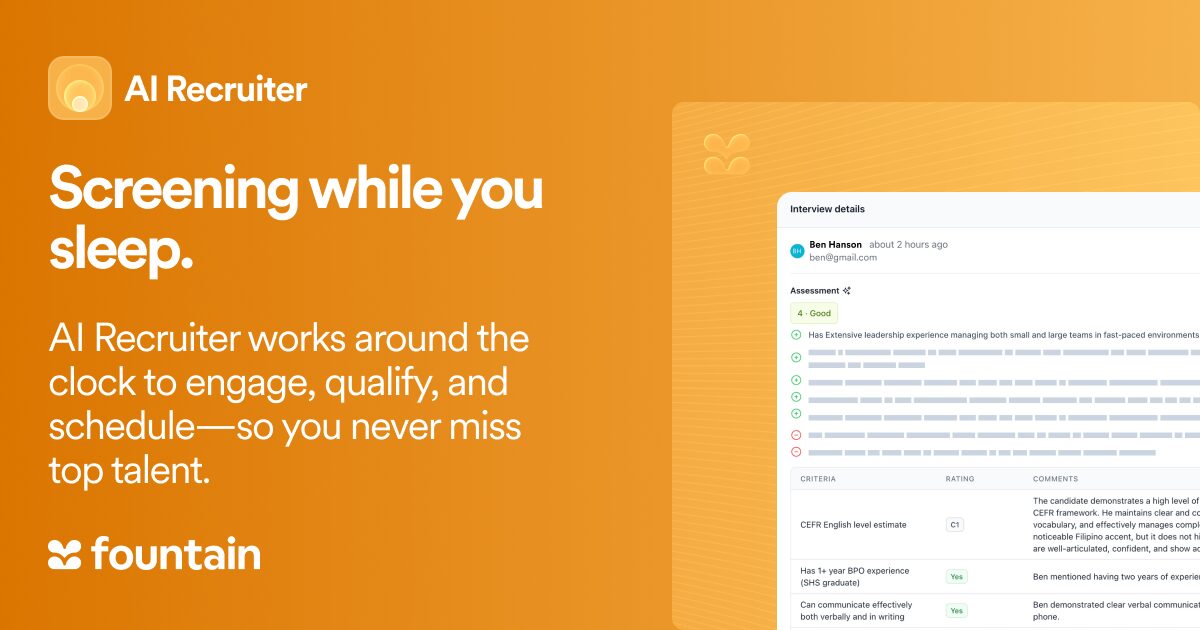
Where a chatbot answers a candidate’s question about store hours, an AI agent detects an open role, screens candidates against that role’s requirements, schedules the interview, sends the reminder, and surfaces qualified workers for open shifts. Recruiters and managers review the outputs and make final decisions.
Not all AI works the same way. AI assistants, AI agents, and agentic AI represent three distinct levels of what the technology can do on its own. Here’s a practical way to think about the three tiers:
- AI assistants respond when asked. A store manager types,”who’s available Saturday?” and the assistant pulls up a list. The manager still has to review it, text each person, and confirm coverage. Every action requires a human prompt.
- AI agents plan and execute multi-step workflows within defined rules. An agent detects that Saturday is understaffed based on forecasted foot traffic, identifies three qualified associates within driving distance who haven’t maxed their weekly hours, sends each one a shift offer via text, and confirms the coverage. The manager gets a notification with the updated schedule to approve.
- Agentic AI coordinates multiple agents working together across systems. One agent screens a batch of seasonal applicants. Another schedules interviews for the top candidates. A third re-engages last year’s holiday workers from the CRM and routes them to open roles. A fourth detects a coverage gap next Friday and surfaces a just-cleared new hire for the shift. In retail, hiring, scheduling, and communications have traditionally lived in disconnected tools. Agentic AI connects them.
Gartner predicts that 40% of enterprise applications will feature task-specific AI agents by 2026, up from less than 5% in 2025. The same research warns against “agentwashing,” where vendors label basic AI assistants as agents.
A tool that requires a recruiter to prompt it before acting is an assistant. But a tool that initiates and carries out multi-step workflows within defined rules is an agent. The label matters because the operational impact is different: assistants save a few clicks per task, agents eliminate entire manual workflow chains.
Benefits of AI agents in retail
Retailers deploying AI agents see impact across five areas:
1. Faster time-to-hire
The 2025 Fountain Frontline Report found that 57% of frontline candidates cite a slow hiring process as their top frustration. The retail industry average sits at 25 to 26 days from application to hire, per Fountain benchmark data. When candidates are choosing between your store and three others within walking distance, that timeline loses people.
AI agents handle the volume work that buries recruiting teams:
- Screening applicants against role requirements
- Scheduling interviews
- Sending reminders
- Following up with candidates who haven’t responded
Fountain’s Agentic AI research puts numbers to the impact: 79% faster time-to-interview and 40% reduction in screening time with AI-driven workflows.
2. Higher show rates and stronger early retention
52% of frontline candidates cite ghosting or lack of updates as a top frustration, per the 2025 Fountain Frontline Report. When communication gaps appear between offer acceptance and the first shift, candidates disengage. Some never show up. Others leave within weeks.
Agents close those gaps by automating the touchpoints that typically fall through the cracks: onboarding reminders, document collection prompts, first-week check-ins, and schedule confirmations.
Stitch Fix, an online personal styling service, increased its first-day show rate from 68% to 95% after deploying automated screening and scheduling workflows. Median time-to-hire dropped from three weeks to 9 days.
That combination of faster hiring and consistent communication is what moves early retention.
3. Smarter shift coverage
Filling roles fast means nothing if you can’t keep shifts covered. The 2025 Fountain Frontline Report found that 82% of employers struggle to hire frontline workers, and Fountain’s Agentic AI research shows 3x turnover variance across locations within the same company. When coverage is managed manually, every last-minute gap pulls managers off the floor to cover it.
AI scheduling agents connect forecasted demand to staffing actions. They:
- Analyze historical traffic and sales patterns to flag understaffed shifts days in advance
- Surface available workers based on qualifications, proximity, and hours remaining
- Send shift offers directly to workers’ phones without a manager dialing through a contact list
AI scheduling agents generate the starting schedule. Managers refine it. The efficiency gain is in eliminating the hours spent building that first draft from scratch, not in removing human judgment from the process.
4. Lower sourcing and recruiting costs
Every unfilled role creates pressure to spend more on job boards. That spend often goes to sourcing new candidates when the best ones are already in your system. AI agents scan past applicants and former employees, match them against open roles, and initiate outreach automatically.
Your last holiday cohort becomes your first call for seasonal ramp, without new sourcing spend. The longer you use agents, the deeper that talent pool gets, which means each hiring cycle costs less than the one before it.
5. More manager time on the floor
SHRM’s 2025 State of the Workplace report shows that many HR departments operated beyond typical capacity in 2024. Every hour a store manager spends scheduling interviews, chasing onboarding paperwork, or calling through a contact list to fill a shift is an hour off the sales floor.
Agents take on the repetitive coordination work: self-scheduled interviews replace back-and-forth emails, mobile onboarding handles document collection, and shift notifications go out automatically when gaps are detected.
That time goes back to coaching teams and serving customers. NRF data shows seasonal hiring buffers are shrinking year over year, which means managers are absorbing more of the staffing burden. Agents reduce that load.
Risks and governance for retail AI agents
Compliance requirements for AI in retail hiring and scheduling are already active and expanding. Retailers deploying agents need to account for these:
- Bias audit laws: NYC Local Law 144 (effective since July 2023) requires annual independent bias audits for automated employment decision tools, public disclosure of audit results, and candidate notice when AI is used in screening. Penalties reach $1,500 per day for subsequent violations. Illinois and other states are following with similar restrictions on discriminatory AI use in employment decisions.
- Predictive scheduling laws: Several jurisdictions require advance notice of schedules and added pay for late changes. AI scheduling systems need to be configured to enforce those requirements wherever they apply.
- Child labor rules: Federal regulations for non-agricultural employment limit 14- and 15-year-olds to 3 hours on school days and 18 hours per school week. State laws can be stricter. Scheduling agents must enforce both.
- Transparency obligations: Disclose when AI is used in hiring or scheduling decisions. Offer candidates and workers a clear path to human review. Aside from being a good practice, it’s also becoming a legal requirement in more jurisdictions every year.
- Human-in-the-loop design: AI handles screening, scheduling, and engagement. Humans make the final call on who gets hired and how consequential decisions are handled. Responsible AI tools make recommendations, not decisions.
This landscape is moving fast. The retailers that build governance into their agent deployment from day one avoid the cost of retrofitting it later.
How to phase in AI agents across retail locations
Most AI deployments stall between pilot and scale. The common mistake is rolling out across all locations on a fixed timeline. A phased approach, gated by performance rather than a calendar, reduces that risk.
Phase 1 (weeks 1 through 8): one use case, one to three pilot stores
Pick a single high-impact function, like interview scheduling for seasonal associates. Run the agent in recommendation mode where it suggests actions and humans approve, with full logging. Establish baselines for time-to-hire, candidate drop-off, and manager time spent on hiring before you turn anything on. You need a clear “before” to measure against.
The goal of this phase isn’t scale. It’s validation. You’re testing whether the agent’s recommendations match what your best recruiters and managers would do on their own. If override rates are high, the agent logic needs tuning before you expand.
Phase 2 (months 2 through 6): validate and expand to 5 to 15 stores
Expansion is contingent on pilot results, not a fixed date. The primary signal to watch is override rate: how often are managers reversing what the agent recommends? High overrides mean the rules need refinement. Low overrides mean the agent is ready for more locations.
This is also where you layer in additional use cases. Start re-engaging past applicants for open roles through your CRM. Add automated onboarding workflows for document collection and compliance tasks. Each new capability should follow the same pattern: recommendation mode first, measure against baselines, expand when the numbers hold.
Phase 3 (months 6 through 12): cross-store shift coverage and scheduling
This is the phase where hiring and scheduling connect. Agents can detect coverage gaps at one location and surface qualified workers from another. That cross-store coordination is where the biggest operational gains sit, but it also requires the most governance.
Formalize what agents do autonomously (sending shift notifications, scheduling interviews) and what requires human approval (cross-store assignments, overtime authorization). Document these rules clearly.
As you add locations, the agents are making more decisions at a higher volume. The governance framework you set in this phase is what keeps things from going sideways at scale.
The retailers that get stuck are usually the ones that try to skip phase 1 or expand before the pilot data supports it. Let performance gate each transition.
Why retail needs a unified platform
Fountain’s Redefining Frontline Operations research shows that 70% of HR employees use three to six apps to complete a single task. That fragmentation makes agents less effective because they can only act on the data and workflows they can access.
When hiring data lives in one system, scheduling in another, and candidate communications in a third, no agent can connect a seasonal rehire in the talent pool to an open shift next Friday.
Fountain’s Frontline Superintelligence solves this by connecting Cue, its AI Copilot, the ATS, CRM, Onboarding, Shift & Scheduling, and Anna in a single platform. Cue is the entry point. Instead of logging into five tools, a regional manager tells Cue: “Rehire our top-performing seasonal workers from last holiday, good standing only, and route them to open roles in the Southeast.”
Cue orchestrates across the:
- CRM (identifies eligible rehires)
- Anna (conducts screening interviews)
- ATS (moves qualified candidates through the workflow)
- Shift & Scheduling (surfaces them for upcoming open shifts)
The team reviews the final slate and makes the hiring decision. Book a demo to see how Fountain fills shifts faster, reduces candidate drop-off, and gets new hires to their first day without errors.
Frequently asked questions about AI agents in retail
What are AI agents in retail?
AI agents in retail are software systems that take goal-directed actions across hiring, scheduling, and workforce management tools without requiring a human to initiate each step.
They screen candidates, schedule interviews, fill open shifts, and re-engage past workers based on defined rules and real-time data. Humans retain decision authority over final hiring and scheduling approvals.
How are retailers using AI for hiring?
Retailers deploy AI hiring tools to screen applicants against role requirements, auto-schedule interviews, send reminders that improve show rates, and re-engage former seasonal workers from talent pools.
Can AI agents help with retail scheduling?
Yes. AI agents detect understaffed shifts, surface available workers based on qualifications and location, send shift offers, and adjust schedules based on demand patterns.
Scheduling agents must enforce labor laws, including predictive scheduling requirements, overtime limits, and child labor hour restrictions. Managers review and approve consequential scheduling decisions.