Fountain focuses on frontline hiring actions, while SmartRecruiters focuses on enterprise recruiting collaboration.
Software is becoming the back end of recruiting, while agents are becoming the front end for screening, scheduling, and applicant communications. The practical question in 2026 is which system can keep candidates moving through early hiring steps while the team stays in control of the final decision. In that frame, Fountain is the stronger fit for high-volume frontline hiring across QSR, retail, logistics, staffing, and healthcare. SmartRecruiters fits enterprise recruiting teams that prioritize collaboration, employer branding, and SAP SuccessFactors alignment.
Frontline candidates apply from their phones between shifts, often submitting to several employers in one sitting before committing to whichever one moves fast enough. Meanwhile, the national median time-to-fill fell to 39 days in 2026, down from 44 the year before, according to SHRM’s 2026 benchmarks. For an operation filling the same role across hundreds of locations, that gap between candidate intent and next step is where the pipeline leaks.
Recruiting platforms now compete on whether their agents and automation can screen candidates, schedule interviews, and keep applicants moving at the volume and speed that frontline hiring demands, while the team keeps control of the final decision. The two platforms split on the work they automate.
TL;DR
Fountain is the better choice when the hiring problem is speed and volume across frontline locations. Its named-agent model centers on Cue and Anna today, while Emma and Sam are roadmap items rather than available agents, and its products cover the path from application through onboarding, scheduling, engagement, and retention.
SmartRecruiters is the better fit when the problem is enterprise coordination across corporate, salaried, and mixed-role hiring, especially for organizations standardizing on SAP SuccessFactors. It is a collaborative recruiting platform with a broad integration marketplace and employer-branding tools, now positioned within SAP SuccessFactors. Buyers evaluating it for frontline roles should test mobile apply flows, batch actions, local-manager workflows, and peak-volume performance first.
At a glance: Fountain and SmartRecruiters
Fountain is Frontline Superintelligence for the global frontline workforce, purpose-built for high-volume, mobile-first hiring across frontline verticals.
SAP completed its acquisition of SmartRecruiters in September 2025, and SmartRecruiters now sits within the SAP SuccessFactors suite. It is a collaborative hiring platform, enterprise recruiting adapted downmarket. It centralizes job posting, candidate tracking, interview feedback, and recruiter and hiring-manager collaboration, and it pairs that with an open marketplace of third-party integrations and employer-branding tools. Its AI centers on sourcing and screening assistants that work across recruiting workflows. Because SmartRecruiters now sits inside SAP, buyers weighing it for frontline roles should also weigh SAP roadmap commitments, data-export terms, and integration dependencies alongside the product itself.
| Fountain | SmartRecruiters | |
| Best fit | High-volume, mobile-first frontline hiring across QSR, retail, logistics, staffing, and healthcare | Enterprise, collaborative recruiting across corporate, salaried, and mixed-role hiring |
| Core products and capabilities | Cue orchestration layer plus ATS, Sourcing, CRM, Onboarding, and Shift & Scheduling | Applicant tracking, sourcing and nurturing, interview collaboration, employer branding, and an integration marketplace |
| Named agent(s) | Anna, the live AI Recruiter. Emma and Sam are roadmap items, not yet available (confirm with Fountain) | AI sourcing and screening assistants, with no live named voice-interviewing agent |
| Frontline hiring fit | Purpose-built: mobile apply with no login, bulk actions, and location-specific workflows | Enterprise recruiting adapted downmarket. Frontline mechanics vary by configuration and should be tested |
| Post-hire coverage | Connected Onboarding (I-9, E-Verify), Shift & Scheduling, engagement, and retention | Handled through the SAP SuccessFactors environment and integration marketplace |
| Integration context | Connects to UKG, SAP, ADP, and Workday through its Integration Center | Open third-party marketplace with native SAP SuccessFactors alignment |
| Caveats | Broader than low-volume, single-location employers need | Now inside SAP, so weigh roadmap commitments, data-export terms, and integration dependencies |
Feature comparison
Both products track applicants. Fountain adds frontline workflows for mobile apply, batch actions, onboarding, and scheduling. SmartRecruiters adds enterprise collaboration, employer branding, a third-party marketplace, and SAP SuccessFactors alignment.
This comparison comes from Fountain and weighs both platforms on the workflows that decide frontline outcomes, namely mobile apply, bulk and batch actions, local-manager workflows, and performance at peak volume. Competitor capabilities, integrations, and contract terms vary by configuration and change over time, so confirm the specifics in a vendor demo before you decide.
AI agents: named roles vs. enterprise assistants
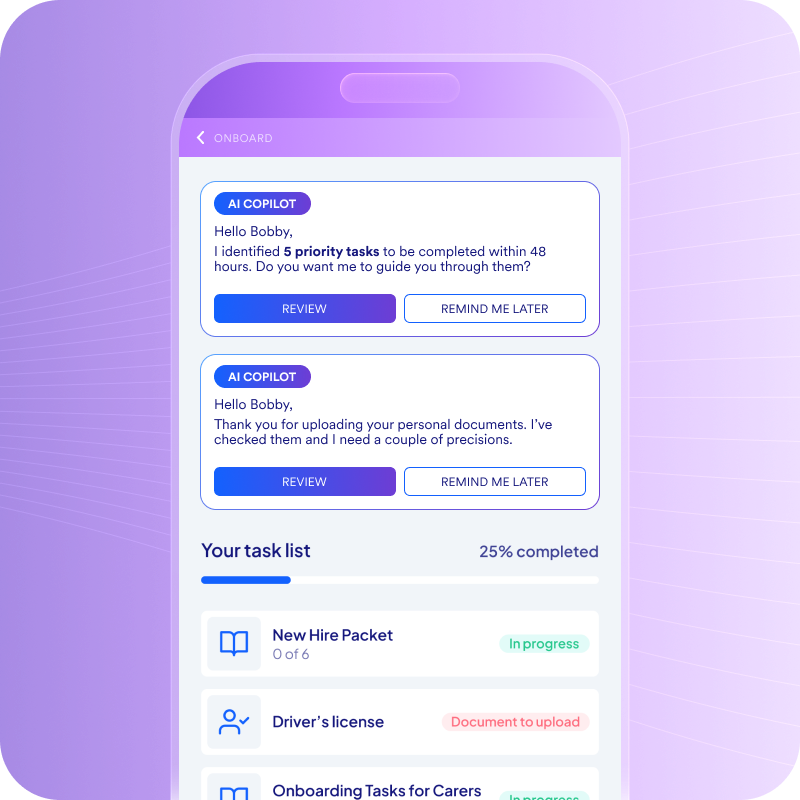
Fountain uses a named, role-based agent model. Cue orchestrates the agents, with Anna available today. Emma and Sam are roadmap items rather than available agents, so confirm current availability with your Fountain contact before evaluating them.
Download the Free Guide: Agentic AI for Frontline Hiring & Retention
Explore how top HR teams are using agentic AI to speed up hiring, improve onboarding, and reduce frontline turnover—at scale. This guide breaks down real-world use cases, ROI benchmarks, and a 90-day roadmap for getting started.
Anna conducts voice interviews around the clock, scores candidates, and routes qualified applicants to TA managers, while people keep the final hiring decision. Fountain reports that Anna, its AI Recruiter, reduces time-to-hire by up to 50 percent. A named role makes the automation easy to test against a specific frontline job.
SmartRecruiters takes a different approach. Its AI centers on sourcing and screening assistants that run across recruiting workflows. Buyers comparing the two should check whether those assistants meet the volume, mobile, and local-manager demands of the frontline roles they’re hiring for. Fountain customers see the speed payoff in practice. At CLEAR, Fountain reduced time-to-hire by a week or more.
Architectural foundation
A corporate ATS assumes one recruiter managing 15 to 20 professional roles. Fountain was designed from day one for frontline work, where turnover is high, requisitions stay open continuously, and a single hourly role draws thousands of applications across hundreds of locations. For operators, that volume is the normal operating environment. Slow screening, weak bulk actions, or poor local visibility turns directly into missed coverage.
SmartRecruiters was built for collaborative, mixed-role enterprise recruiting, where the priority is coordination across recruiters, hiring managers, and agencies rather than volume throughput. The shortlist should start with the hiring pattern you need to support, before the ATS category label.
Mobile application experience and completion
Mobile has been the majority channel for job applications for years. Appcast’s 2020 benchmark put mobile at 60.7 percent of all applications, the first year mobile applies overtook desktop. Completion is where employers lose people. Glassdoor’s mobile-job-search research finds that mobile seekers complete 53 percent fewer applications and take 80 percent longer than desktop users. On desktop-first flows, that gap becomes a revenue problem.
Fountain’s mobile-first design targets this gap directly, and candidates apply from any device with no account creation. On SmartRecruiters, the mobile candidate flow varies by employer configuration, so the configured experience is worth checking before committing.
High-volume bulk actions and multi-location
At peak volume, the difference shows up in batch actions, local-manager workflows, and system performance under load. When store, warehouse, or branch managers hire locally, they may text candidates, schedule interviews, or make offers before the ATS reflects the change, and the system needs to keep those actions inside the workflow. Fountain manages hiring across hundreds or thousands of locations from one platform, with location-specific workflows and bulk actions built in. Central visibility and local execution coexist, so managers don’t have to work around the system. UPS hires 100,000 workers in six weeks through Fountain, which shows the kind of surge throughput logistics and seasonal employers need when delayed hiring immediately affects coverage.
Post-hire and integration
Fountain covers Onboarding with I-9 and E-Verify, Shift & Scheduling, engagement, and retention as connected products. It connects to UKG, SAP, ADP, and Workday through its Integration Center as the frontline orchestration layer for your existing stack. SmartRecruiters concentrates on the recruiting workflow itself, with post-hire steps handled through its SAP SuccessFactors environment and its integration marketplace, a genuine strength for buyers who want broad third-party reach. The right model depends on where your requirements are heaviest, whether that is connected frontline operations or enterprise recruiting breadth.
Pricing
Neither platform publishes fully transparent public pricing, and both price for their target markets. SmartRecruiters prices for enterprise buyers and doesn’t publish a full public rate card. Because it’s now owned by SAP, buyers should negotiate feature-parity and data-portability protections.
Fountain prices for high-volume frontline employers and is built to deliver ROI at scale. Its core products come in three tiers, Essential, Accelerate, and Enterprise, that map to different levels of frontline hiring maturity. For budget owners, that means tying the pricing conversation to hiring volume, compliance needs, and automation scope rather than a flat ATS comparison.
The pricing reflects enterprise-grade infrastructure, compliance tooling, and AI agents that pencil out when you’re filling hundreds or thousands of roles. Low-volume or single-location employers may find the platform broader than they need. For committed pricing, both vendors direct buyers to their sales teams.
Who should choose Fountain?
Fountain fits when open shifts stay unfilled across many locations and your team needs faster screening, scheduling, onboarding, and shift assignment. If you’re a TA director or VP of operations filling the same hourly role continuously, Fountain’s architecture matches your reality. The Bojangles case study cut time-to-hire from 30 days to 5.8 days, an 80 percent reduction, while cutting job-board spend 86 percent across 750 locations. The Fetch case study compressed time-to-hire from 15 days to 6.5 hours while managing a 325 percent increase in applicant volume with three recruiters. Stitch Fix lifted the share of applicants who pass background checks and show up on Day 1 from 68 percent to 95 percent by automating warehouse hiring.
Fountain also fits when your recruiting team is at capacity and you can’t add headcount in step with volume. Liveops runs a 44,000-to-1 applicant-to-recruiter ratio at a 100 percent fill rate, the recruiter-capacity argument in its most extreme form. For TA leaders, that means automation can protect service levels when applicant volume would otherwise outrun the team.
Compliance rounds out the fit. Onboarding handles I-9, E-Verify, and audit-ready documentation, which matters because ICE reported roughly 6,450 I-9 audits in fiscal year 2019, a level of enforcement that turns manual documentation gaps into legal and operational risk. If you want a frontline hiring layer for your existing HCM, Fountain connects to UKG, SAP, ADP, and Workday.
Who should choose SmartRecruiters?
SmartRecruiters fits when your hiring spans both corporate and frontline roles and collaborative recruiting is central to how your team works. It’s a strong fit for enterprise organizations that want one platform for professional, salaried, and hourly hiring, where deep recruiting workflows, employer-branding tools, and a broad integration marketplace earn its place in the evaluation. If your process depends on structured collaboration between recruiters, hiring managers, and external agencies, its collaboration workflows are worth weighing against the handoffs your team runs every day.
It also makes sense for companies consolidating onto SAP SuccessFactors. If SAP is your system of record, SmartRecruiters reduces integration work by connecting natively into it. It’s a credible enterprise choice for organizations that need process discipline and cross-functional alignment across a mixed workforce more than mobile-first speed and bulk actions at frontline volume.
Conclusion
Fountain wins for high-volume frontline hiring speed, while SmartRecruiters fits mixed enterprise recruiting where collaboration, SAP integration, and marketplace breadth matter most. Fountain is built specifically for the frontline. It delivers mobile-first application flows and Anna screening and interviewing at volume while your team decides. Bulk actions and multi-location management fit the way local managers actually hire, and post-hire products carry a worker from application to Day 1 and beyond.
If unfilled shifts cost revenue every hour and candidates take the first offer that moves fast enough, the platform that keeps qualified applicants moving has the advantage. Fountain was built for frontline speed, with people still accountable for the final hiring decision.
Book a demo to see how Fountain handles high-volume frontline hiring across your locations.
Frequently asked questions about Fountain and SmartRecruiters
Is SmartRecruiters still an independent company?
No. SAP completed its acquisition of SmartRecruiters in September 2025, and the product is now positioned within the SAP SuccessFactors suite. For procurement and HR technology leaders, the decision now extends beyond SmartRecruiters’ current feature set to SAP roadmap alignment, data dependency, and contract protections. Buyers should weigh the longer-term SAP dependency and negotiate protections around feature parity and data portability.
What makes a hiring platform “purpose-built for frontline”?
A frontline-native platform is designed around the realities of high-volume hourly hiring. It combines mobile-first applications with no login required, continuous requisitions that stay open across hundreds of locations, bulk actions for managing thousands of applicants, and downstream integration into onboarding, scheduling, and compliance. It also keeps both central teams and local managers inside one workflow, and when it doesn’t, candidates and offers spill into manual workarounds. Enterprise ATS platforms adapted for hourly hiring often bolt these on as modules rather than building them into the foundation.
How fast can frontline hiring realistically move?
Frontline hiring often moves faster than the national median. SHRM’s 2026 benchmarks put the median time-to-fill at 39 days, down from 44 the year before, and Navero reports retail hiring at roughly 25 days. Purpose-built platforms compress it further, and the Fountain Bojangles case study reports a drop from 30 days to under six. Every day above the frontline norm raises the odds that a candidate accepts another hourly offer before your process finishes.
Does AI make the hiring decision on these platforms?
No, and it shouldn’t. Both Fountain and SmartRecruiters keep humans in the loop, and Fountain’s Anna screens, interviews, and scores candidates before routing qualified applicants to your team for the final call. That matches candidate expectations, since 67 percent say they’re comfortable with AI handling initial screening as long as a person makes the final decision, according to herohunt’s 2025 review. AI works as a capacity and speed layer, and people stay accountable for the final judgment.